
Read Time: 6 minutes
Summary: Families aren’t just watching the calendar this fall, they’re watching for signals. Is this school a partner, or just another place sending information? Here are 5 simple ways to shape that answer in the first month, and the tools that make doing it at scale actually possible.
Written by Kate Pechacek
The first weeks of school are spent building routines. Students are learning where to go, what to bring, what their teachers expect, and how to navigate a new year’s social circles. Teachers are learning their students. School leaders are watching arrival, dismissal, attendance, behavior, and a hundred other indicators for signs that systems are working as intended.
But another important process is happening at the same time: families are learning what kind of relationship they can expect to have with their child’s school. Will I hear from the teacher only when something goes wrong? Will I understand the information the school sends me? If I have a question, will someone respond? Does the school really want my perspective, or does family engagement mostly mean keeping me informed? Will I know who to reach out to and how to reach them if I have important questions or information to share?
Those early experiences matter because trust is cumulative. It is built through repeated interactions that tell families, sometimes explicitly and sometimes very subtly, “We know your child. We value what you know about them. And we need you on the team.” The good news is that building that foundation doesn’t require an elaborate new initiative. The first month offers dozens of natural opportunities to do it well.
- Make the first interaction intentionally positive
This sounds simple, but it may be one of the most important things a school can do, and in some ways is not always intuitive at a time when there is so much information to share.
Before you start that flood of information sharing and before there is a missing assignment, an attendance concern, or a behavior issue, give every family an opportunity to hear something positive about their child. It doesn’t have to be profound. At a leadership level, a message might be “We are very focused on supporting your child in identifying their strengths this year”. At the classroom level, it might look more specific. “Maya helped another student today.” “Carlos asked a terrific question in science.” “I’m really enjoying getting to know Jordan.”
A small message changes the starting point of the relationship. If a difficult conversation eventually becomes necessary, the family already knows the school sees more in their child than the problem being discussed.
At the district level, leaders can make this explicit by setting a simple expectation: every family receives a positive connection early in the year, not just the families whose children immediately stand out.
See how TalkingPoints makes this easy: With Quick Kudos, teachers can send a positive message to a family in seconds, right from the app.
- Ask before you assume
Educators spend the first several weeks gathering enormous amounts of information about students. Families have information that no assessment, cumulative file, or data system can provide. Ask for it. What motivates your child? What makes school difficult? What are they excited about this year? Is there anything you wish their teacher understood about them?
The specific questions matter less than the message behind them: You are the expert on your child, and what you know matters here. It also gives educators something incredibly valuable: context. A behavior that might otherwise look like disengagement may make considerably more sense once a teacher understands what is happening around the student. A student is highly engaged on the days they get to present to the class because that student has always loved a performance. Knowing more about students has always been a desire of teachers and school staff, and the family is a student’s first teacher and biggest personal advocate.
- Don’t confuse sending information with communication
Back-to-school communication can quickly become an avalanche. Calendars, handbooks, transportation information, lunch accounts, technology agreements, attendance policies, schedules, forms and, inevitably, at least one password someone has already forgotten. Schools need to send this information. But information delivered is not necessarily information received, and information received is not necessarily information understood.
During the first month, pay attention to whether families can actually access and understand what you’re sending. Use plain language. Communicate in families’ preferred languages. Make the most important information easy to find. Most importantly, give families an easy way to respond. Communication becomes trust-building when it stops being something schools send and starts becoming something schools and families do together.
See how TalkingPoints makes this easy: Messages can be translated into more than 150 languages, built specifically for preK-12 communication so school terms come through clearly, not just word-for-word.
- Establish partnership before you need it
One of the worst times to introduce the idea of family partnership is in the middle of a problem.
Instead, use the first month to establish how the relationship will work. Let families know how and when teachers will communicate. Tell them how to ask questions and share concerns. Explain that educators want to hear what families are seeing at home and that reaching out early is welcomed.
This matters especially for attendance, academics, behavior, and well-being. When partnership has already been established, an emerging concern becomes something to understand and address together rather than a problem the school reports to a family. The difference may seem small. The experience for families can be enormous.
- Build consistency from the classroom to the district
Families don’t experience a district through its strategic plan. They experience it through people: a teacher’s message, a conversation with the attendance office, a principal at drop-off, a district email, a call to the transportation department. The first month is therefore an important opportunity to make sure those interactions reinforce the same basic message: families are respected, welcomed, and essential partners in student success.
This requires two levels of family engagement.
- Around the classroom, district and school leaders create the culture, systems, expectations, and supports that make effective partnership possible.
- In the classroom, families experience that commitment personally, frequently, and specifically through the people working with their child.
When those levels align, a district’s vision for family engagement stops being something families are told and becomes something they experience.
See how TalkingPoints makes this easy: Shared templates and unified school and district messaging tools help districts and classrooms speak with one consistent voice, in every family’s preferred language.
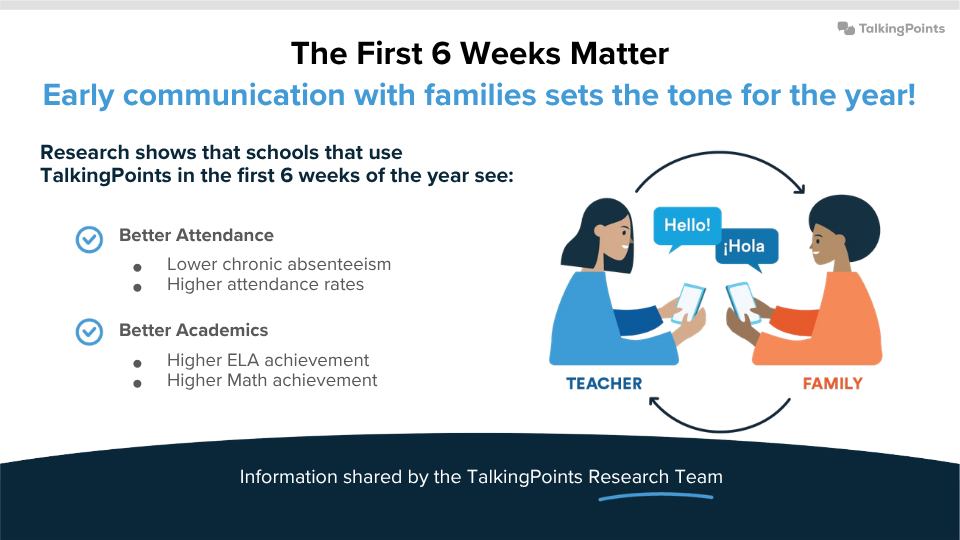
The challenge isn’t knowing what to do. It’s doing it for everyone.
None of these five practices is particularly complicated. The challenge is making them happen consistently across hundreds or thousands of students, educators, interactions, languages, and family circumstances. That’s where technology should make family engagement easier, not simply make communication faster.
At TalkingPoints, we think about effective digital family engagement as four connected steps: Reach, Communicate, Engage, Improve. First, schools have to reliably reach every family. Then communication has to be understandable and genuinely two-way. That communication can develop into trusting engagement when feelings of mutual respect and partnership take hold, and those relationships can ultimately be leveraged to improve student outcomes.
Technology can’t manufacture trust, and it shouldn’t try to. Trust will always be human. But the right technology can remove the barriers that make it extraordinarily difficult for educators to build those human relationships equitably and at scale. TalkingPoints’ text-first approach, two-way communication in 150+ languages, K-12 contextualized translation, embedded family engagement guidance, and outcomes-specific features (e.g. Attendance Improvement or Academics at Home) are designed to help educators do exactly that.
The first month of school will be busy no matter what. But amid all the routines being established, don’t overlook one of the most important: how your schools and families will work together this year. Because the relationships you build when everything is going well are the relationships you’ll depend on when things get hard.