Written by Amanda Ensor
Time to read: 5 minutes
Summary:
- Why a one-minute text on a child’s first day of school can build more trust than any formal communication plan
- The mindset shift behind relationships-first schools: communication is the doorway, relationships are the destination
- A practical starting point: protecting just 10-15 minutes for positive outreach, no new program required
- Plus, links to the full webinar recording and resource guide to help your team put this into practice
What if the most important thing we do for students this year begins long before the first assignment, attendance concern, or report card? What if it begins with a relationship?
During our recent Start Strong: Relationships First conversation, family engagement expert Ari Gerzon-Kessler, founder and CEO of Same Team Consulting and author of On the Same Team, shared a story that has stayed with me. It was his daughter’s first day of school. She was two and a half years old and, until then, had spent most of her days at home surrounded by familiar people and places. That morning, Ari did what so many parents and caregivers have done: he left his crying child in an unfamiliar place and walked away. As he drove to work, the questions came. Is she okay? Is someone comforting her? Does she feel safe? Then his phone buzzed. It was a text from her teacher, Miss Stephanie. She simply wanted him to know that his daughter had settled in well and had already made a few friends. The message probably took less than a minute to send. Ari’s reaction was immediate: You have my trust. The message wasn’t a curriculum update, reminder, request, or problem to solve. It simply said: I see your child.
I know you are wondering. I thought about you. And in that tiny moment, something much bigger began.
Before Partnership Comes Trust
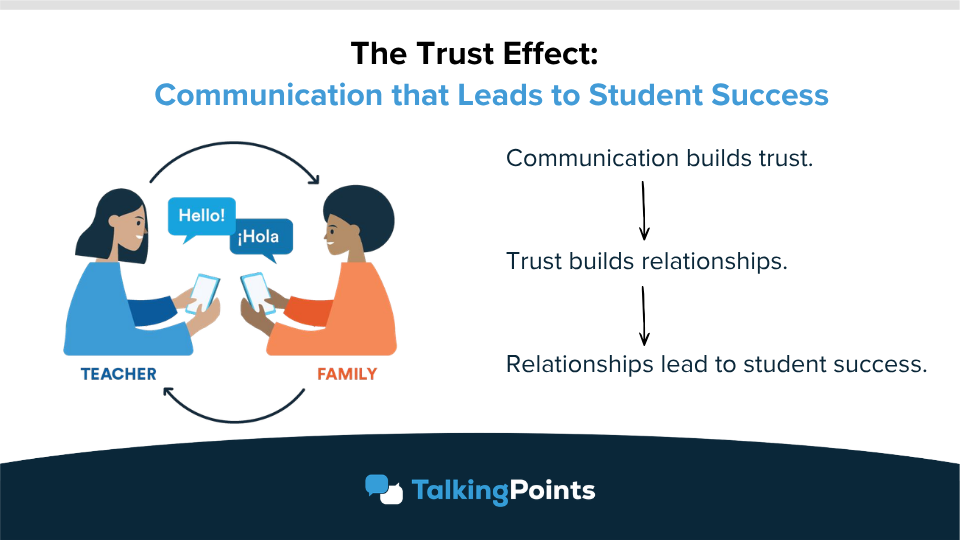
At TalkingPoints, we spend a lot of time thinking about communication. But communication has never been the final destination. Communication builds trust. Trust builds relationships. Relationships create the conditions for student success. Communication is the doorway. Relationships are what we are trying to build on the other side. That distinction matters because school communication can easily become transactional: attendance reminders, assignment updates, permission slips, calendar changes, behavior concerns. Those messages are necessary. But families need more than information. They need to know the people caring for their children. They need opportunities to respond. They need to feel that their knowledge of their child matters. Most importantly, they need to know we are on the same team. Ari challenged us to consider whether relationship-building is truly part of how school happens every day or something we hope happens along the way. Because relationships cannot depend on luck. They begin from day one.
The Difference Between Being Served and Being Seen
Ari shared another simple example. While moving through airport security, a TSA agent looked at his identification, handed it back and said, “Here you go, Ari.” Later, another employee greeted him with a smile and wished him a great day. His name. A smile. A warm goodbye. Almost no additional time. But the interaction felt different. It felt human. That’s the point. Extraordinary cultures are often created through very ordinary actions, repeated intentionally: Knowing someone’s name. Asking instead of assuming. Listening instead of telling. Reaching out before there is a problem. Helping someone feel expected rather than processed. The same is true in schools.
Small Things. Done Consistently.
Putting relationships first does not mean asking educators to take on another enormous initiative. Ari described schools that intentionally protect just 10 or 15 minutes for positive outreach through TalkingPoints, phone calls, or postcards. A few minutes. A positive message. A small amount of time with a potentially enormous relational return. Instead of hoping family engagement fits somewhere into an already packed day, they make room for it. That is the difference between a good intention and a system.
This Is Why TalkingPoints Exists
At Eisenhower Elementary, Ari saw what happens when schools remove barriers to those everyday relationships. Spanish-speaking families had essentially one pathway for communicating with the school: a single Spanish-speaking staff member. Teachers and families cared deeply about the same children, but there was no reliable bridge between them. After staff began using TalkingPoints for translated two-way communication, thousands of messages moved directly between educators and families. Ari described the change as an “utter transformation.” But the transformation wasn’t really about message counts. It was about conversations that could finally happen. Questions families could finally ask. Teachers who could finally hear directly from caregivers. Technology alone does not create partnership. People do. But the right communication infrastructure can make the human things easier to do consistently:
Hello.
What should I know about your child?
Something wonderful happened today.
I noticed something feels different. Is everything okay?
Those small exchanges build trust over time.
Students Live Inside These Relationships
Children do not experience home and school as completely separate worlds. They live inside the relationship between them. Think about how different school feels when a child knows their family and teacher communicate comfortably and trust one another. The child no longer has to serve as the bridge between disconnected adults. The adults become the bridge around the child. That is why relationships-first is not simply a family engagement strategy. It is a student success strategy.
Relationships First
Maybe a relationships-first school year does not begin with a massive initiative. Maybe it begins with one interaction. One positive message. One parent’s name remembered at arrival. One question asked with genuine curiosity. One moment when a family realizes: This educator sees my child. Because the message is not the relationship. The message opens the door. And when schools make those moments intentional and consistent, we build something far more powerful than communication. We build trust. We build partnership. We build a network of adults ready to work together around the child they all care about.
How we begin matters.
So before the first problem needs solving, before the first difficult conversation, before we need families to trust us, let’s give them a reason to.
Relationships first. From day one.
Want to Hear More From Ari?
This piece only captures part of the conversation. In our recent Start Strong webinar, Ari Gerzon-Kessler sat down with Amanda to talk through what it actually looks like to build relationship-first partnerships across a school or district, not as an add-on, but as the foundation everything else is built on.
Watch the recording to hear more stories like the ones above, along with a shared framework your team can start using right away. And if you want to put these ideas into practice, the accompanying resource kit is built to help you do exactly that: prioritize relationships from day one, without adding another thing to anyone’s plate.