Written by Rob Bayuk in partnership with Angela Dregier, Multilingual Family Engagement Specialist, and Laura Schreiber, ELD Specialist, Baltimore County Public Schools
Part One of a Two-Part Series
Baltimore County Public Schools (BCPS) doesn’t have a simple story to tell about multilingual families.
With 108,017 students, more than 13,000 multilingual learners, and families from 122 countries speaking 114 home languages, BCPS is one of the most linguistically diverse districts on the East Coast, and it has grown more so every year. In 2005, the district served roughly 3,400 English learners. Today that number has nearly quadrupled.
The district had invested accordingly. Sixty interpreters. LanguageLine for translation. A full communications department. Still, they knew they could do more, reaching families on their own terms.
The question wasn’t whether Baltimore County cared about multilingual family engagement. It was why the infrastructure it had built wasn’t producing the partnership and connection it wanted.
Silence Gets Misread
Angela Dregier has been with Baltimore County Public Schools for 26 years, the last three as Multilingual Family Engagement Specialist in the Office of Multilingual Achievement. She has watched the district’s multilingual population grow from a small corner of a larger story to a central challenge shaping everything from staffing to curriculum to family outreach.
“For a long time, engagement barriers weren’t about interest, they were about access,” she says. “But that was often misinterpreted as a lack of interest.”
It’s a distinction that carries real consequences. When a family doesn’t respond to a school newsletter, or doesn’t show up to a parent night, schools can read that silence as indifference. Angela’s conviction is that the silence usually means something different: the system needed to keep that family’s reality in mind, not interpret their absence as a lack of interest.
“Early on, it was about translating information and meeting compliance requirements,” she reflects. “Now it’s about partnership and trust.”
That shift didn’t come from the top down. It started with a teacher, a phone, and seventy-five families who needed to be reached.
Starting Small, Then Going Big
When COVID-19 closed BCPS schools in the spring of 2020, Laura Schreiber was an ELD teacher trying to stay connected with her multilingual families who had little or no internet access. So she did what teachers do when the system isn’t working: she found something that was.
She started using TalkingPoints to send messages to families in their home languages through a simple, text-based interface. Families could respond. In real time. In the language they actually spoke.
District leaders quickly saw a bigger opportunity: this wasn’t just a tool for one group of families. It was a way to make school communication more equitable for everyone. By late 2023, the district formalized what was already happening. In a matter of weeks, the number of families rostered grew from roughly 13,000 to more than 111,000.
What began in multilingual education became a districtwide commitment built on a simple belief: every family deserves access to two-way communication with their child’s school. It’s a commitment Superintendent Dr. Myriam Rogers has spoken about at the state level, telling the Maryland State Board of Education:
“TalkingPoints has been a game changer to our school system. It is easy to use for teachers and for schools…we have received significant positive feedback around the use of TalkingPoints.” – Dr. Myriam Rogers, former Superintendent, Baltimore County Public Schools
What Two-Way Actually Means: Connection
It would be easy to describe TalkingPoints as a translation tool. It is that. But describing it only as translation misses what Baltimore County has learned about why it works.
The key isn’t the language. It’s the connection it enables you to make with families — at all levels.
“When multilingual families can ask questions, share concerns, and respond easily,” Angela says, “they build confidence to reach out. They stop being passive recipients of information and become true partners in their child’s education.”
“When you build rapport… it really does build that trust, and trust is so important, especially for our multilingual families.” – Angela Dregier, Multilingual Family Engagement Specialist, Baltimore County Public Schools
That shift from passive to active turns out to matter in measurable ways. TalkingPoints partnered with BCPS to conduct a formal research study across all 174 schools, asking a harder question than adoption rates: was this actually affecting student outcomes?
The answer was yes.
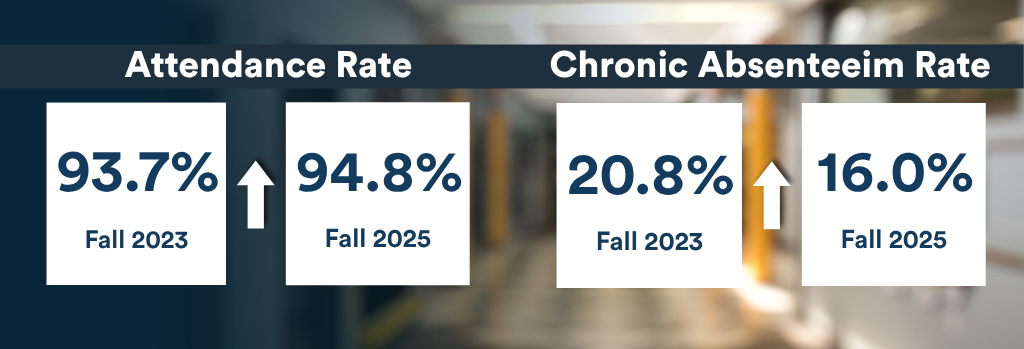
Attendance district-wide rose from 93.7% to 94.8% — a statistically significant gain of 1.1 percentage points. Chronic absenteeism fell from 20.8% to 16.0%, a drop of nearly five points. And the data showed a meaningful link between two-way communication — not just messages sent, but messages exchanged — and lower suspension rates.
 *Statistically significant improvement
Suspension improvement rates (1.65 → 1.67) were not statistically significant.
Angela is careful about the causality. “When we first implemented TalkingPoints, we weren’t focused on attendance at all,” she says. “The goal was simply to engage families more meaningfully. Improved attendance was the byproduct of stronger relationships and earlier problem-solving.”
That framing — attendance as a byproduct of trust, not the target of a campaign — is important. What happened at BCPS wasn’t a clever intervention. It was something more durable: a change in the relationship between schools and families.
The Importance of the First Six Weeks
One of the sharper findings in the research points to something teachers may have discovered intuitively before anyone studied it formally: the strongest link between family communication and attendance gains came from outreach in the first six weeks of the school year.
Laura Schreiber, who now leads instructional work in the Office of Multilingual Achievement and coordinates the district’s TalkingPoints literacy pilot, sees this pattern in how the best teachers use the platform.
“In those first six weeks, teachers weren’t just sharing rules or logistics. They were setting the tone for the year. They were introducing themselves, asking families about students’ needs, and normalizing two-way communication.” – Laura Schreiber, ELD Specialist, Baltimore County Public Schools
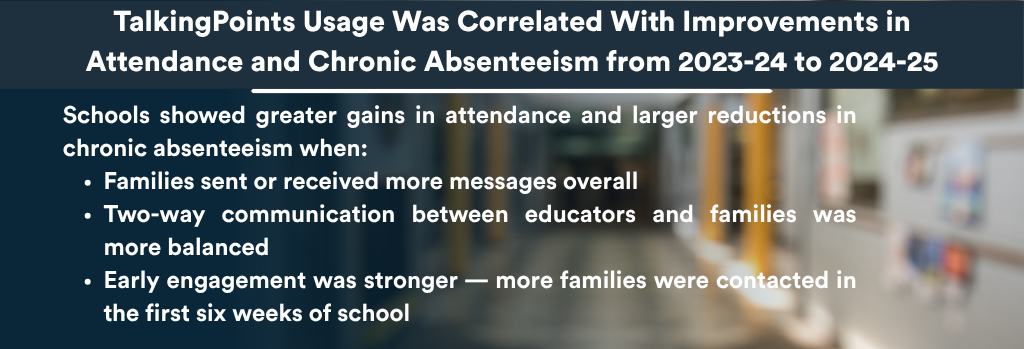
The research data backs this up. Schools showed greater gains in attendance and larger reductions in chronic absenteeism when families sent or received more messages overall, when communication between educators and families was more balanced — truly two-way — and when early engagement was stronger, with more families contacted in those critical first six weeks.
“Families were more likely to respond, explain what was going on, and work with schools before absences became chronic,” Angela adds. “We didn’t set out to change attendance. But by investing in engagement and trust, attendance improved.”
Real Impact with Families and Students
The research tells the district-level story. But Angela thinks about it differently when she’s talking to a principal or a new teacher. She thinks about specific moments.
One that stays with her: a family reached out through TalkingPoints to share something they’d carried quietly, a mental health challenge at home that was affecting their child’s attendance, something they’d never told the school before. They weren’t avoiding the school; they just hadn’t had a comfortable way to start that conversation.
A text message was the way in.
“The fact that they felt comfortable enough to reach out via text rather than avoiding a phone call made all the difference,” she says. “That message allowed the school to respond with flexibility and support instead of assumptions.”
That’s the shift Angela comes back to when she talks about what TalkingPoints actually changed. Not the volume of messages. Not the reach rate, though 99% of BCPS families are now reachable via SMS through TalkingPoints. It’s the quality of what happens when the channel is open and the trust is built: families stop waiting for the school to find them and start reaching out on their own.
“It made me realize TalkingPoints wasn’t just improving communication,” she says. “It was changing how parents feel about whether their input matters.”
What Comes Next: The Bridge to Student Outcomes
For Baltimore County, the question that has driven this work from the beginning is simple: what does it take for a family to feel like a real partner in their child’s education?
Two-way communication in families’ home languages turned out to be foundational. And that foundation matters for what comes next. That kind of partnership with families actively supporting learning at home doesn’t happen without trust. It requires families to feel seen, to trust the channel, and to believe the school genuinely wants them as partners. That relationship is built through two-way conversation, consistent early outreach, and the simple act of making it possible for families to respond in their own language.
As Laura Schreiber puts it: “We need to bridge what’s happening in the schoolhouse and what’s happening at home.”
Partnering with Families to Improve Literacy
That bridge is now being built in a new direction. During the 2025-2026 school year, ten Baltimore County elementary schools piloted TalkingPoints Academics at Home, a simple way for schools and districts to send literacy and math activities home, translated into families’ home languages, and aligned directly to what’s happening in the classroom. With a focus on PreK-2 literacy, BCPS is making a high-impact, strategic investment in student reading proficiency during a critical window of development.
TalkingPoints Academics at Home activities are designed for real life: a few minutes at the dinner table, a quick exercise at a stoplight, using the district’s own curriculum — and requiring no extra prep work for teachers.
While teachers and families actively engaged and responded positively to the pilot, BCPS is approaching it thoughtfully. But for Laura, who helped design the instructional alignment, and for Angela, who is coordinating the family engagement side, it represents something they’ve been building toward for years. The groundwork for this moment wasn’t laid in the pilot design — it was laid every time a family sent a message and got one back, learning that their voice was welcome and their input mattered.
Baltimore County Public Schools is expanding TalkingPoints Academics at Home to all elementary schools districtwide for the 2026-27 school year.
The trust is there. The channel is open. Now they’re asking what it can carry.
See the full impact with Baltimore County’s research findings here.
In Part Two of this series, two teachers share how they were able to build on their work with families to focus on engaging families to support early literacy at home. BCPS was the first district to pilot TalkingPoints Academics at Home. Hear how families not only responded positively, but then started to ask, “what more can we do?”
Is your district ready to build the same foundation? Learn how TalkingPoints Foundations helps districts like BCPS reach every family — in their language, in real time, in both directions. [Learn more about TalkingPoints Foundations]