By: Katie James, PhD and Mallary I. Swartz, PhD
What if one of the most powerful tools for improving student attendance and behavior wasn’t a new curriculum or an expensive intervention, but a simple text message to families?
A new study examining TalkingPoints implementation in a large urban district found that meaningful, positive family-school communication was associated with a 12% increase in high school attendance and a 43% reduction in suspensions in early and middle grades. Crucially, those gains held for Black students, Latino students, English learners, and economically disadvantaged students — the very groups that most often face the largest barriers to engagement.
The findings add rigorous evidence to something educators have long sensed: when schools communicate with families in ways that are positive, accessible, and consistent, students do better. This study shows what that looks like at scale.
Key Findings
Key Finding #1: High School Attendance Increased by 12%
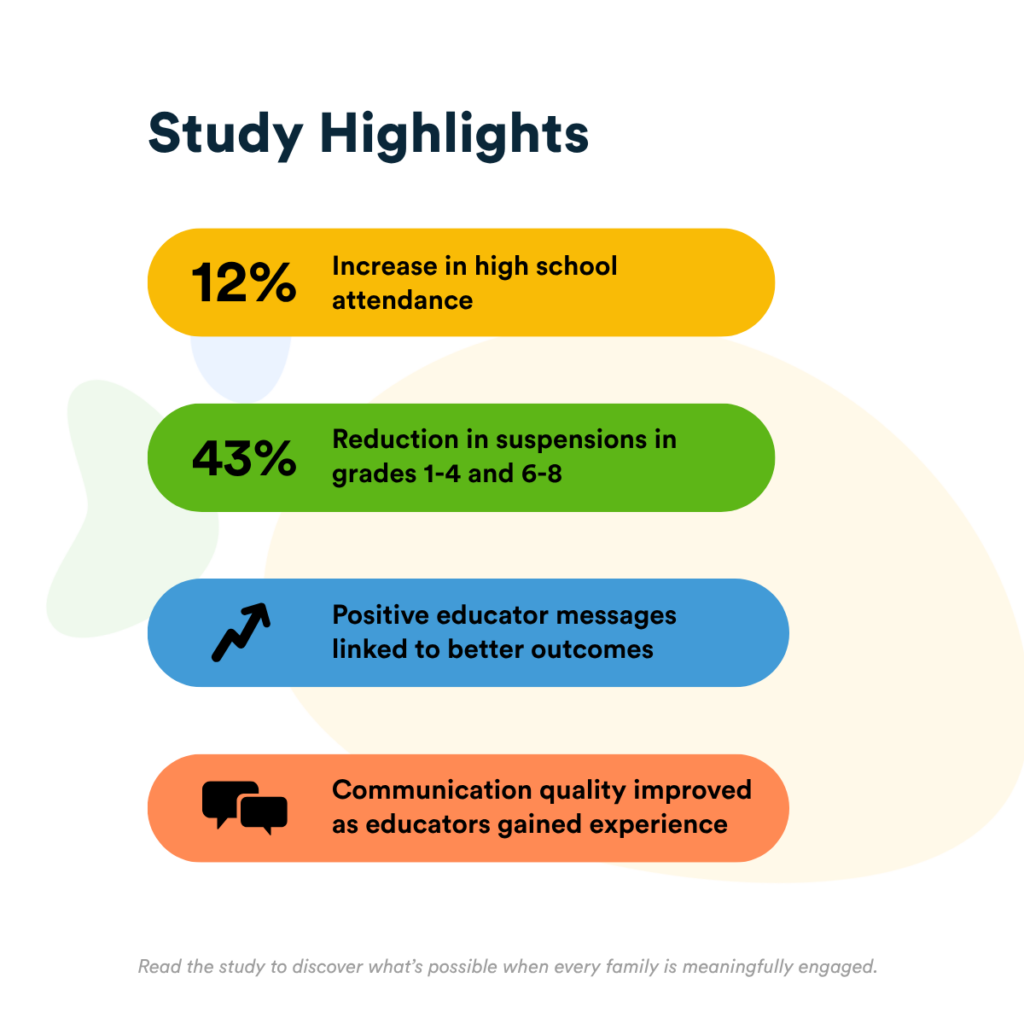 TalkingPoints usage was associated with a 12 percentage point increase in attendance among high school students. That’s nearly three additional weeks of learning time per year.
The gains weren’t limited to any one group. Black students, Hispanic/Latino students, English learners, students with IEPs, and economically disadvantaged students all showed statistically significant attendance improvements. That consistency across subgroups is significant — it suggests TalkingPoints is reaching the students who most need additional support, not just those who are already well-connected.
What this means for districts: Attendance interventions often focus on student behavior and include incentives, monitoring, outreach after absences occur. This research points to a different lever: proactive family-school communication. When families are informed, included, and treated as partners, they’re better positioned to help address attendance challenges before they become chronic.
Key Finding #2: Suspensions Dropped by 43% in Early and Middle Grades
In grades 1–4 and 6–8, students in the TalkingPoints group had a 43% lower suspension rate than those in the control group. Again, this held across racial and demographic subgroups.
Every suspension is a missed day of learning. For students at elevated risk of exclusionary discipline – disproportionately students of color and students with disabilities — those missed days compound over time. A 43% reduction isn’t just a statistic; it represents thousands of students who stayed in classrooms instead of being sent home.
What this means for districts: Exclusionary discipline doesn’t start in high school – patterns often form early. Building strong school-family partnerships in the elementary and middle grades, before behavior problems escalate, may be one of the most effective prevention strategies available. This research suggests that when families feel like genuine partners, early concerns get addressed collaboratively rather than punitively.
Key Finding #3: Positive Messages Are Linked to Better Outcomes
Students who received a higher proportion of positive messages had both higher attendance and lower suspension rates. The correlations were modest for any single student, but statistically significant — and at the scale of a 50,000-student district, they add up.
This finding reinforces a core principle of effective family engagement: communication that centers strengths and builds relational trust produces better results than communication that is reactive or problem-focused. Families who hear from schools only when something is wrong start to dread those calls. Families who regularly receive encouraging updates show up differently — and so do their children.
What this means for districts: How educators communicate matters just as much as how often. Tone, topic, and timing all shape outcomes. Districts that invest in building educator capacity around positive, relationship-oriented messaging are likely to see stronger results — not just in engagement, but in attendance and behavior.
Key Finding #4: Communication Quality Improved Over Time
In the first year of implementation, 88% of messages focused on logistics — schedules, reminders, administrative updates. By year two, that share had dropped to 73%, while the proportion of messages addressing academics, attendance, and behavior rose to 16%. The share of positive educator messages grew from 55% to 62%.
What this means for districts: Family engagement practice deepens with time and support. As educators become more comfortable using TalkingPoints, their communication naturally shifts toward the kinds of substantive, relationship-building exchanges that research links to better outcomes. Implementation isn’t a one-time event — it’s a process, and the data gets better as educators grow into it.
About the Study
This research examined TalkingPoints usage across a large, diverse urban district in the Northeast serving approximately 50,000 students across 120 PreK-12 schools. The study covered the 2020-21 and 2021-22 school years — the two years following district-wide adoption of TalkingPoints – using 2018-19 as a baseline. The study used a quasi-experimental design to compare students across TalkingPoints user and non-user (control) groups.
The student sample reflected the district’s diversity: 45% identified as Hispanic/Latino, 38% as Black, and 79% were identified as economically disadvantaged. Twenty-five percent had an IEP, and 35% were English learners.
In short: this was a real-world test in a large, complex district — exactly the kind of place where family engagement can be challenging to get right at scale.
Read the full study: Boosting Attendance and Reducing Suspensions with TalkingPoints.
Practice Implications
What does this mean for district and school leaders? The research points to a clear direction. Here is what it looks like in practice at every level of a district.
District Leaders
District leaders set the conditions that make effective family-school communication possible.
Family-school communication should be embedded in your attendance improvement and school climate plans — not treated as a standalone initiative. When schools communicate proactively and positively with families, they create the conditions to address challenges early, before concerns escalate into absences or disciplinary action.
Make sure communication is accessible for every family. Language barriers and technology gaps prevent many families from engaging with schools, even when they want to. Prioritizing tools that support multilingual communication and reach families on the devices they already use removes a barrier that data shows disproportionately affects the families who need connection most.
School Leaders
Set expectations for proactive outreach. Encourage teachers to connect with families regularly, not only when concerns arise. Brief, positive updates about student participation or effort don’t require much time, but they build the relational foundation that makes harder conversations possible later.
Tie family communication to your existing school initiatives. When outreach is integrated into attendance monitoring, PBIS, or MTSS rather than treated as a separate task, it becomes part of how your school supports students — not an add-on.
For Teachers and Family Liaisons
Start early. A personalized message at the beginning of the school year sets a relational tone that can carry through the whole year — and makes it far easier to engage families when challenges come up.
Invite two-way communication. When families feel like their perspective is welcome, they share insights about their child that educators can’t get any other way. Two-way communication turns a school-to-home broadcast into a genuine partnership.
How TalkingPoints Makes This Possible at Scale
The challenge in large, multilingual districts isn’t knowing that family engagement matters — it’s making it actually happen across hundreds of classrooms with limited educator time and families who speak dozens of languages.
TalkingPoints is designed to remove both of those barriers at once. Educators get AI-powered tools and research-backed message templates that make best-practice communication manageable even with limited capacity. Families receive messages as texts – no app, no download, no Wi-Fi required – with built-in two-way translation in more than 150 languages. For families who want more support, the TalkingPoints for Families app includes text-to-speech, education glossaries, and tools that help families understand school communications in their home language.
The shift in communication quality observed in this study, from logistics-heavy, problem-focused messages toward more positive, outcomes-oriented exchanges, didn’t happen by accident. It happened because TalkingPoints makes that kind of communication easier to do consistently, at scale, in real school conditions.
This is where TalkingPoints plays a key role: not just providing a communication tool, but embedding the conditions for meaningful partnership into everyday practice.
The Bottom Line
Attendance and behavior are urgent priorities for districts nationwide. And the solutions that work aren’t always the most complicated ones.
This study adds to a growing body of rigorous evidence that when schools build genuine partnerships with families rooted in accessibility, trust, and positive communication, students show up more and get sent home less. That’s true for all students, and especially for the students who have historically faced the most barriers.
The question for district and school leaders isn’t whether family engagement matters. The evidence on that is clear. The question is: what structures, tools, and habits are you building to make it happen consistently for every family?
Ready to see how TalkingPoints can support attendance and behavior improvement in your district? Book a demo with our team.
Celebrating 10 years of partnership and impact
For a decade, TalkingPoints has supported students, families, and educators through the power of effective family-school partnerships. As an education technology nonprofit, our award-winning communication and family engagement platform has improved outcomes for districts and students nationwide.
We connect 9 million+ educators, students, and family members annually and have facilitated more than one billion conversations, building trust, fostering relationships, and fueling student success. Named by Common Sense Education as “the best overall family communication platform for teachers and schools,” TalkingPoints drives measurable gains in attendance and academic achievement, backed by rigorous, causal research.
Join us in building a future where every child has the support they need to thrive.