
Driving Student Outcomes Guide
Explore how TalkingPoints helps students thrive by building trusting relationships between families and schools. This guide highlights the solutions’ impact on attendance, academic achievement, and student well-being.
Effective Family-School Partnerships Lead to Improved Student Attendance: How the TalkingPoints Universal Family Engagement Platform Decreased Absence in Tulsa Public Schools
This study of 30,000 students from Tulsa Public Schools uncovers the impact of TalkingPoints on student attendance. Findings show a statistically significant decrease in absenteeism rates and an increase in days students are present in school.
Conversation Dynamics: Findings and Recommendations from an Analysis of Quality vs. Quantity in School-Family Communications
TalkingPoints researchers analyze 40 million messages sent within the TalkingPoints platform to understand the dynamic engagement between schools and families. Topics, tone, timing, and staff role all are all research factors studied in this report.
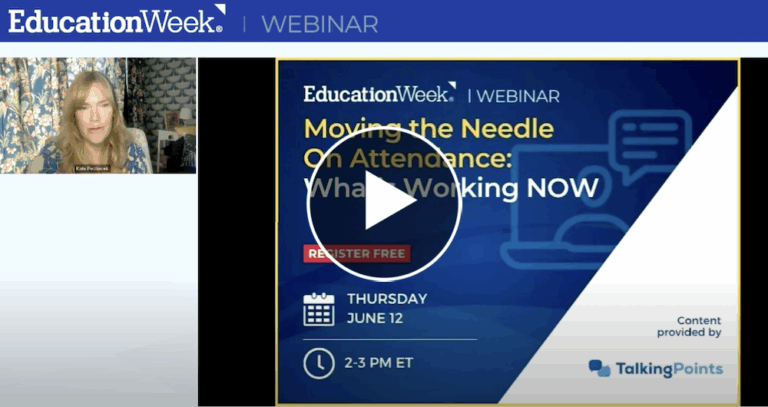
Moving the Needle on Attendance: What’s Working NOW
Discover what’s driving real attendance gains today. This webinar features breakthrough strategies, new data, and lessons from Tulsa Public Schools—plus expert insights from Attendance Works and TalkingPoints on how family partnerships can shift outcomes. Watch now for actionable ideas you can use immediately.
Benchmark Report
This benchmark survey of more than 600 teachers and school and district administrators explores how districts implement family engagement best practices and their impact on student outcomes.
Family-School Partnerships Improve Attendance and Behavior: How the TalkingPoints Platform Boosted Outcomes in a Large Urban District
This study of nearly 34,000 students from a large urban district reveals how TalkingPoints helped improve high school attendance and reduce suspensions in early and middle grades. Students using TalkingPoints gained the equivalent of three extra weeks of learning time per year and experienced a 43% lower suspension rate than peers.