This post is part two of our Green Bay Area Public Schools (GBAPS) co-authored series on how schools are using TalkingPoints to build stronger relationships with families.
Contributors:
- Courtney Kuehn Principal
- Tim Larsen, Associate Principal
- Luis Franco, Bilingual Family Engagement Coordinator

Today we’re spotlighting Preble High School, Wisconsin’s third-largest high school, with 2,200 students and 275 staff, and highlighting how its leaders are proving that “big” doesn’t have to mean “impersonal.”
Principal Courtney Kuehn is clear about Preble’s philosophy: size will never be a barrier towards building and developing personal family relationships. Kuehn sums it up succinctly: “…the only bad communication is the communication that never happens.”
“We are big, but families need to be in communication with their teachers. They deserve to know what’s going on within their child’s education. While we are big, we want to make sure that we’re not using that as an excuse not to be responsive to our families.”
That belief shows up in small but powerful ways. For example, Preble hand-signs every honor roll certificate—no electronic signatures—because they refuse to let scale get in the way of a personal touch. As Kuehn puts it, they don’t want to be “defined by our size in a negative sense,” but instead want that size to be “a true asset to everything that we can provide.”
Turning a large school into a network of relationships
Associate Principal Tim Larsen notes that a school of Preble’s size could easily feel anonymous. Instead, the leadership team has made a conscious decision to turn scale into a strength by being systematic and personal.
One key driver of that work: TalkingPoints.
When the platform was first rolled out, some staff were unsure about it.
“When TalkingPoints was first rolled out to staff, I think naturally some staff saw it as, okay, I’m sending a text message to families? Somehow that might seem… unprofessional,” Larsen recalls.
Kuehn and Larsen tackled that directly during August back-to-school prep, using training and hands-on practice to reframe TalkingPoints as a way to “meet families where they’re at” and communicate in ways that are convenient and accessible for them.
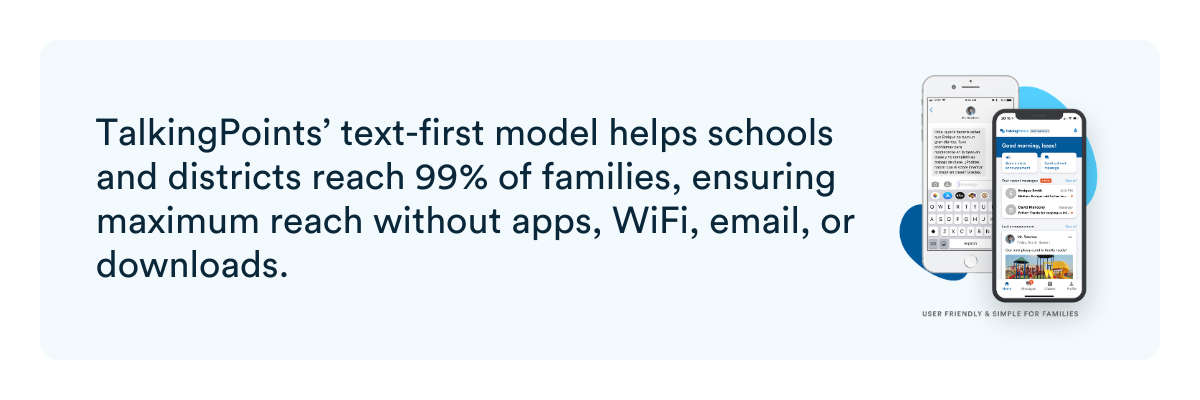
They started simple. During a staff meeting, everyone opened TalkingPoints and sent one positive message to one family. That low-stakes first action helped build comfort and confidence, and usage quickly grew from there.
Start Strong: Using data to drive family engagement in high schools
Preble’s deeper push into TalkingPoints came with GBAPS’s Start Strong initiative: a six-week effort at the beginning of the school year across 21 schools to proactively get to know families and their students in those crucial early weeks.
At Preble, that work was rooted in data. The school had surveyed both students and families and saw a clear theme: a need for stronger belonging.
“We take our surveys very seriously… a sense of belonging comes through frequently,” Kuehn explains.
They paired that with TalkingPoints usage data from the previous year and saw that many instructional staff were still hesitant to use the platform, often because they weren’t confident that messages would go where they intended or translate the way they hoped.
Larsen led targeted onboarding and support sessions to close that gap, building staff capacity and comfort. Start Strong added structure and momentum:
- Teachers received weekly TalkingPoints activity ideas and question prompts to spark two-way conversations with families.
- Administrators got parallel messages that explained the research behind those prompts and suggested ways to encourage staff.
The goal was to make it easy for teachers during the busiest part of the year to take that “extra step” and initiate real dialogue with families from day one.
The results:
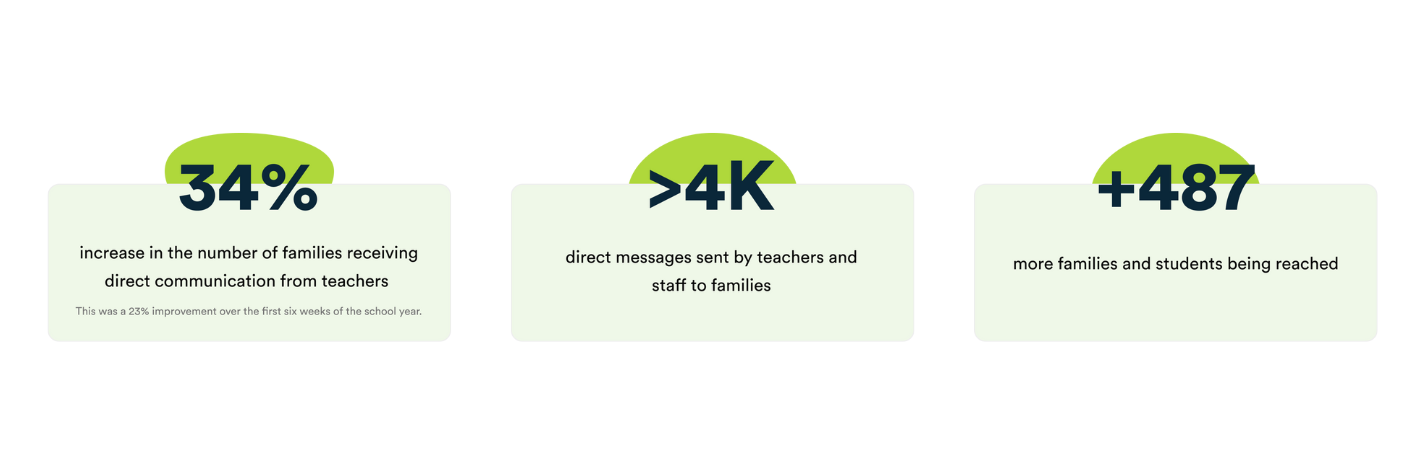
- 34% increase in the number of families receiving direct communication from teachers, which was a 23% improvement over the first six weeks of the school year
- 487 more families & students being reached at Preble in those early weeks
- The momentum continued with 4,148 direct messages sent by teachers and staff in the first semester, and 4,361 direct messages sent by families in that same time frame
From “too-late” conferences to formative, helpful communication
One place where TalkingPoints has been especially powerful is Preble’s “unit-by-unit” grading system. All coursework for a unit is due by the end of that unit, so clear, timely communication matters.
Before TalkingPoints, parent-teacher conferences were one of the main structured touchpoints. But Kuehn notes, relying on conferences alone has its limits. In the past, they used conferences to give families a snapshot of where their students were in a given unit, but it was often too late if students had missed a deadline. With TalkingPoints teachers are regularly communicating about key milestones so students are supported from multiple sources, specifically:
- Staff send reminders about unit deadlines, what content to study, and what assignments are still missing.
- Families respond with specific questions, like noticing a missing assignment and asking about its status.
- Teachers reply in real time, clarifying what’s already in the gradebook and what’s still being entered.
Mr. Larsen notes, “Rather than just retroactively waiting to see what’s going to show up in our student information system, they can have that real time conversation earlier. And as a result, the relationships grow a lot closer,” and families are able to offer support along the way.
Using technology to feel more human, not less
In a large school, efficiency is essential, but Preble’s leaders insist it can’t come at the cost of relationships. Larsen highlights how certain TalkingPoints features help them to build these personal relationships.
“When sending messages to multiple families, it’s so slick. As parents, we love to see our student’s name in the communication, not just something generic like ‘your child.’ TalkingPoints lets you easily insert the student’s name, even when sending a message to multiple families. It makes the teacher’s job easier, but more importantly, it makes the communication more powerful.”
It’s not just teachers using the platform. The administrative team relies on TalkingPoints for attendance conversations and re-engagement support. Larsen shares that having these relationships lays the foundation for other conversations with students, whether it’s an attendance issue or an academic one. And just knowing how a family wants to be communicated with makes that communication more efficient and effective.
If a family works during the day and can’t answer calls, Laren uses TalkingPoints instead:
“They’ll be able to check that message and respond to it on their own time. For many of our families, Talking Points is now their preferred method of communication.”
Family engagement provides the glue to build success from elementary to graduation
Family Engagement Coordinator Luis Franco-Toscano connects Preble’s work to a broader, long-term view. He has served Green Bay schools for 27 years, thirteen of those as a family engagement coordinator supporting the “Preble track,” families from elementary that feed into Preble High School. All three of his own children attended Preble, so his connection to the school is both professional and personal.
He describes Preble as a model for the district in how it approaches everything from an open house to registration, with “many different resources that are not only language sensitive” and a clear focus on building relationships from day one.
From Mr. Franco-Toscano’s conversations with families, one theme stands out: messages sent through TalkingPoints feel deeply personal.
“A lot of the parents feel like those are personal invitations. They have a personal relationship with a teacher. They have a personal relationship with a counselor. They feel contextualized on a personal matter.”
Franco-Toscano feels these relationships built in the earlier years help as students transition from school to school, helping students and families feel more immediately connected. Franco-Toscano says: “Things get a little murky, where the family has to maneuver through different apps, different resources [at different schools] to achieve the same common goal.” However, TalkingPoints helps the communication and personal connections stay consistent across the school years.
Mr. Franco-Toscano says TalkingPoints provides:
- Continuity across grade levels and buildings
- Reduced anxiety for families who might otherwise feel “not be in the know”
- Stronger cultural identity and access through translation and multilingual support
For Franco-Toscano, TalkingPoints is “the humanizing aspect of an academic environment,” something he notes is “not as common as you would think” in other edtech tools.
Advice for school leaders
For other principals and school leaders considering a deeper investment in family engagement as a key strategy, the Preble team offers this advice:
- Start small to build trust and confidence. Have staff send one simple, positive message during a meeting. It’s a quick way to lower the stakes and demonstrate how easy and impactful the tool can be.
- Protect time for practice. Don’t assume staff will “just figure it out.” Preble’s August onboarding and support sessions were critical to overcoming hesitation and building real comfort with the platform.
- Be systematic, but still personal. Especially in large schools, taking advantage of TalkingPoints features like personalizing group messages help you communicate efficiently without sacrificing that “this is about your child” feeling.
- Meet families where they are. When families can respond on their own time, and in their own language, engagement goes up.
- Think long-term. Treat communication as a continuous journey—from registration to graduation—not a set of isolated events.
Two ideas for school and district leaders to consider as they evolve their family engagement initiatives.
For Preble High School, family engagement isn’t an extra initiative; its core to how a large, complex school becomes a connected community. And TalkingPoints is one of the key tools helping them live out that belief, one message and one relationship at a time.
For part three of this three-part collaboration series with Green Bay Area Public Schools, see how Nicolet Elementary School used TalkingPoints to start this year strong.