This post is part three of our Green Bay Area Public Schools (GBAPS) co‑authored series on how schools are using TalkingPoints to build stronger relationships with families.
Contributors:
- Lori McArthur, Principal

Today we’re spotlighting Nicolet Elementary School—a bilingual, neighborhood school where deep community roots and new communication habits are helping families feel seen, heard, and connected.
Principal Lori McArthur has worked at Nicolet Elementary for 28 years. She now leads a school where many of her current students are the grandchildren of her former students. The community is close‑knit and diverse, with predominantly Spanish‑speaking families and additional home languages including Hmong, Somali, and Haitian Creole.
Like many schools, Nicolet has faced challenges in elementary family engagement:
- Families working multiple jobs and juggling complicated schedules
- Parents who felt intimidated by school settings and educators
- Language barriers that made consistent, two‑way communication difficult
Despite these barriers, one thing has always been clear to McArthur: families care deeply about their children. The challenge has been finding ways to help them connect to what is going on at school that is accessible, respectful, and sustainable for staff and families alike.
This year, Nicolet’s participation in Green Bay’s Start Strong initiative, supported by TalkingPoints, helped the school take a significant step forward. This six-week outreach effort, starting at the beginning of the school year, set out to connect early with families, learn about every student, and build and establish relationships with all families.
From scattered tools to one goal: Open up two-way conversations
In previous years, communication at Nicolet varied widely from classroom to classroom.
“Last year we had different things going on,” Lori explained. “We had teachers doing Seesaw, using other apps and making phone calls. We had teachers spending time communicating in all of these different ways. The challenge that we ran into with that is that parents wouldn’t answer the phone, and there wasn’t a clear channel to expect and engage in communication with the school.”
Heading into the 2025–26 school year, McArthur and her staff wanted to focus on building regular, two‑way communication between teachers and families. McArthur notes, “We wanted to have a two‑way conversation between teachers and families. And as I have a generally younger staff, communicating by texting was natural and easy.”
To take advantage of TalkingPoints’ text-first approach, Nicolet made TalkingPoints the primary platform as it was reaching more families, enabling home language communication, and most importantly, opening a door for a two-way conversation.
Launching with intention: Open house + Start Strong
Nicolet used the beginning of the school year to embed TalkingPoints into the fabric of their routines.
What they did
- Printed TalkingPoints flyers to build awareness for families and prepared staff to support enrollment
- Used their back‑to‑school open house to walk families through setup and answer questions on the spot.
- Provided directions in multiple languages and explicitly framed TalkingPoints as the main way families would hear from the school and their child’s teacher.
- Sent follow‑up reminders during the second week of school and a clear message: “We’re all trying to get on TalkingPoints—here’s why.”
What they saw
As part of the district’s six‑week Start Strong initiative with TalkingPoints, Nicolet focused their early-year outreach on relationship building, not logistics. Teachers received simple prompts and activity ideas designed to:
- Introduce themselves in a personal way
- Ask families about their child as a person and a learner
- Share early photos and stories from the classroom
- Invite questions and feedback
For Nicolet, this approach paid off quickly.
The results:
-
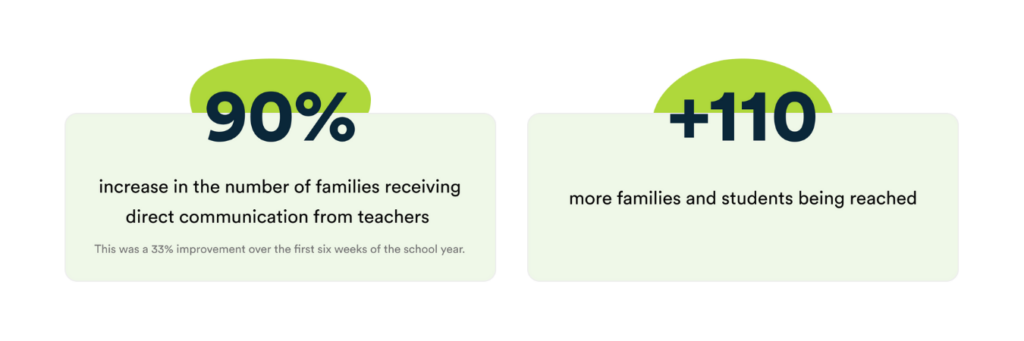
- 90% increase in the number of families receiving direct communication from teachers – a 33% improvement since the start of this project
-
- 110 more families & students being reached
Language access as a foundation, not a bonus
As a bilingual school serving a multilingual community, Nicolet’s family engagement work depends on clear communication in families’ home languages. That’s where TalkingPoints’ translation has been critical.
“That’s a big thing for us,” McArthur emphasizes. “We’re a bilingual school. So TalkingPoints makes it easy to translate messages and videos for us rather than me having to get it done ahead of time.”
Teachers who don’t share a family’s home language can still communicate confidently. They write in English, and TalkingPoints translates into the family’s language. Families respond in their home language, and messages are translated back for the teacher.
Making communication more personal
While McArthur is a principal who loves connecting in person, “I’m more of a go out and talk to the parents,” she also recognizes that many families feel more comfortable engaging via their phones. To bridge that gap, she set a personal goal: send a video to families at least once a month through TalkingPoints. Just to give quick updates and so they can see me and talk,” she explains. And she’s noticed more responses over time.
How she uses it
- Records brief video messages directly in TalkingPoints
- Keeps it short and focused
- Uses the automatic translation for videos, so every family can understand the message in their home language
- Changes the times she sends the messages to find the best time, and it turns out mid-afternoon tends to be when families engage most
“I’ve kind of got it down,” she says. “I know how many characters it needs to be. So I’m really quick, concise and to the point. I’ve had great positive feedback from families.”
For Nicolet, these videos do more than share information: they help families put a face and voice to “the principal” and reduce the intimidation factor that can come with entering the building.
Ms. McArthur shares why family (and how) family engagement is making a difference in their school.
Messages that build a positive attendance culture
Nicolet has also begun using TalkingPoints to address a perennial challenge: attendance.
McArthur noticed a concerning pattern at Nicolet: students being consistently picked up early. “We saw this trend around picking up students at 3 o’clock. They’re missing 25 minutes of school every day,” she explains. “And 25 minutes every day adds up to be a considerable amount of school.”
Using TalkingPoints, Nicolet sends short, translated messages with the goal of educating families on the importance of attendance and why it matters. These messages are simple and straightforward, and they:
- Explain how frequent early pickups add up to significant lost instructional time
- Share simple, visual examples of what that missed time looks like over weeks and months
- Help families see the long‑term impact on learning, without blame or shame
Nicolet uses a combination of their own personalized messages along with the TalkingPoints Attendance Weekly Messaging Series, which are pre-built, research-backed messages that aim to educate and motivate families to ensure their students are in school.
The impact has been noticeable:
- Fewer families are picking students up early
- Some parents responded, saying they “never realized” the cumulative effect
- Attendance conversations feel more like shared problem‑solving than enforcement
Real‑time connection and partnership in the classroom
The impact of these new habits appears in small, everyday interactions between families and teachers. McArthur sees it in messages like: “…[student] has had a difficult morning. Could you just touch base with him? Let me know if you need anything.”
“For a teacher to get that beforehand, that’s a lot more helpful,” she says. And it’s reassuring for parents, “They know they can get right through to the teacher. If they call the desk or if they’re here, they’re not going to get through to the teacher. This is quick and easy.”
She also emphasizes the importance of having the foundation of these two-way connections and conversations, it is all part of building trust and relationships.
“If you get something from a parent, you need to respond back, because that’s what they’re looking for,” she tells her team. “That’s what’s going to build that trust. That is what’s been much better this year.”
Thoughts for school and district leaders to consider.
Advice for elementary school leaders
For other principals and school leaders considering a deeper investment in family engagement for elementary schools and tools like TalkingPoints, McArthur offers several lessons from Nicolet’s journey:
- Treat family engagement as partnership. “Family engagement is partnering,” she says. “It’s a give and take, back and forth. Instead of us telling them, we need to ask them, and we need to work with them.”
- Don’t confuse silence with disinterest. Many Nicolet families work multiple jobs or carry difficult past school experiences. “We can’t assume that they don’t care about their kid because they’re not answering you or because they don’t show up,” says McArthur. “Everyone cares. It shows differently for each person.”
- Meet families where they already are—on their phones. Long emails and phone calls aren’t always realistic. Quick, translated text messages are much more accessible for many families and staff.
- Make it a schoolwide expectation, not an optional extra. Setting TalkingPoints as a school goal, launching it at a back-to-school open house, and modeling it as a principal helped Nicolet move from scattered efforts to a coherent approach.
Looking ahead
As the school year continues, McArthur and her team plan to keep building on what’s working:
- Expanding the use of TalkingPoints for family events and invitations
- Continuing monthly principal video messages
- Encouraging more teachers to experiment with videos, photos, and surveys
- Integrating attendance education and family voice into ongoing communication
For Nicolet Elementary, TalkingPoints is not “the strategy” on its own. It’s a practical, everyday tool that helps make a long‑standing belief visible: families are essential partners in student success, and schools have a responsibility to meet them where they are.
Across this three‑part series—from the district lens, to Preble High School, to Nicolet Elementary—the throughline is clear. When schools honor families’ perspectives, remove barriers like language and time, and commit to two‑way communication as a core part of their work, family engagement becomes less of an event and part of the culture.