Part One of a Three-Part Series
Contributors:
- Ingrid Parker-Hill, Director of Engagement
- Michelle Thompson, Title I Program Support Teacher
- Luis Franco, Bilingual Family Engagement Coordinator
- Carrie Rogers, Family Engagement Coordinator

When Green Bay Area Public Schools (GBAPS) first began formalizing family engagement in schools, the work often meant responding to urgent needs as they came up. Thirteen years ago, the district took a pivotal step toward building stronger connections by hiring its first Family Engagement Coordinator, Luis Franco-Toscano—a move that signaled a shift toward intentional partnership with families.
Luis recalls those early days vividly: “Parent concerns were getting routed to so many different departments—it felt scattered,” he says. Back then, the work was mostly reactive. But over time, things began to change.
“It hasn’t been until the last three years or so that I can truly feel we’re developing a systemic approach to family engagement—something built to last, something sustainable,” Luis reflects.
Today, family engagement in the Green Bay School District is embedded in the district’s strategic plan, and it is part of student and school success goals.
It’s a non‑negotiable part of how the district does school.
From reactive to proactive: A district-level strategy
Michelle Thompson has worked in GBAPS for more than 30 years and now supports Title I schools and programs. Ms. Thompson has watched this evolution.
Early efforts, she notes, were about “doing something for families, such as offering an event and assigning a person or a few people to make it happen.” In recent years, leadership has shifted to treating family engagement as a true school improvement strategy:
“Our district leadership is recognizing the decades of research telling us that involved families have an impact on student achievement. If kids have families that are involved, they will perform better regardless of socioeconomic status, and that’s huge.”
She credits families themselves as a major driver:
“They ask questions. They want to be involved. They advocate for their children. They want to partner with us…They pushed us in a good way to where we are today.”
For GBAPS, the mindset is clear: all parents want what’s best for their children.
The district is responsible for creating a welcoming environment and removing barriers, ensuring families can fully engage as partners. This includes enabling communications in families’ home language, making communication easy through simple text messages, and connecting in-person opportunities and events with digital communication.
Centering trust, identity, and shared responsibility
Carrie Rogers, Family Engagement Coordinator, frames the work as building trust and shared responsibility for whole child development.
She describes the core goal:
- Families should not have to change who they are when they walk into school.
- Schools must recognize and leverage “families’ gifts” and “students’ gifts.”
- Families are treated as the student’s first teacher, and as essential partners, not as audiences.
Their work with families consistently surfaces three foundational questions parents have:
- What will my child learn this year?
- Where are they actually at academically?
- How do I help them at home?
Green Bay has started to design experiences and tools that explicitly answer these questions and empower families so conferences and events become true two‑way engagements, not one‑way information channels.
Turning a crisis into an opportunity: Enter TalkingPoints
For Ingrid Parker-Hill, Director of Engagement, the pandemic marked a turning point—and a positive one for Green Bay.
When schools closed, GBAPS adopted TalkingPoints to stay connected with multilingual families. The platform offered a simple way for staff and families to communicate in home languages, sparking rapid change.
“In the midst of the pandemic, we had to move at lightning speed to meet students’ needs,” Parker-Hill recalls. “That urgency opened a window for families to engage in ways they hadn’t before.”
What started as a multilingual communication tool has now transformed into a universal family engagement platform. TalkingPoints now serves as a districtwide connector for all families.
Parker-Hill emphasizes a guiding principle: ‘What you do for one, you can do for all.’ Today, TalkingPoints not only strengthens communication with multilingual families—it’s driving two-way engagement across the entire district.
The “Start Strong” focus: Six weeks of intentional connection
To push engagement earlier and more intentionally, Green Bay partnered with TalkingPoints on a six‑week “Start Strong” initiative at the beginning of the 2025-26 school year.
What they did
- Encouraged teachers to send a weekly series of early, relational messages to families.
- Used simple tools and templates embedded in TalkingPoints to keep the lift low and to open a channel for connection.
- Positioned “Start Strong” as part of building classroom and school culture in the first weeks, with a focus on getting to know each student.
- Shared the research-backed rationale for each outreach with school leaders to help them support their teachers.
What they saw
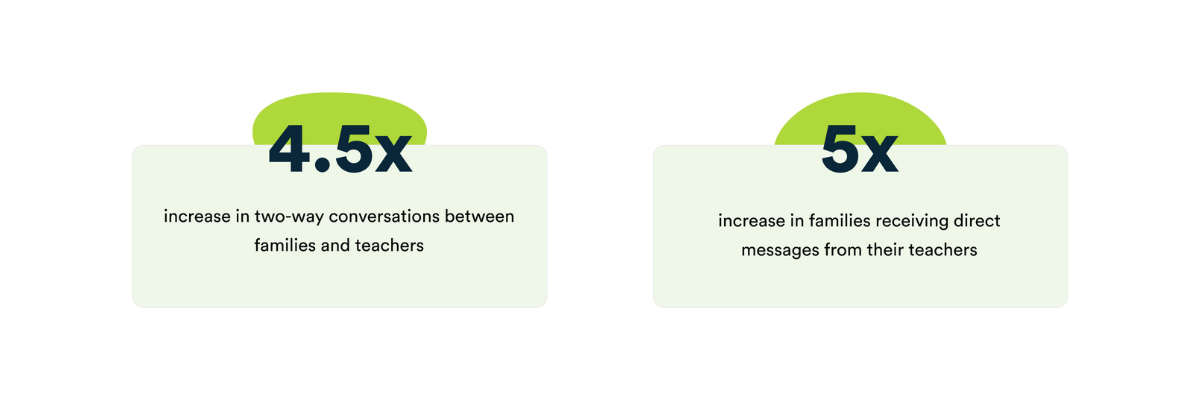
- Noticeable increases in two‑way messaging—teachers weren’t just broadcasting; they were hearing back and starting real dialogues about their new students, ultimately seeing a 4.5x increase in two-way conversations between families and teachers as compared with the same period last year.
- Word‑of‑mouth momentum: teachers who tried TalkingPointsit and saw results began emailing colleagues to say, “You’ve got to check this out.”
- Overall, the 21 participating schools saw a 5x increase in families receiving direct messages from their teachers.
Ms. Parker-Hill is proud of the outcomes, but she also sees room to improve. Providing more time for prep and planning would help it become part of each school’s back-to-school plans. While this year’s initiative was focused on only half of the GBAPS schools, Parker-Hill hopes to include all schools across the district next year.
“Sometimes you have to act when the opportunity presents itself—and that’s exactly what happened with the Start Strong pilot. Although it came together quickly, early data and qualitative feedback convinced Green Bay that this approach works and should become part of ongoing improvement cycles—not just a one-time effort. It’s a low-lift, high-impact way to boost student success, and leaders are now exploring how to embed these habits throughout the school year.”
Building habits, not one-off campaigns: 100-day improvement cycles
A key part of Green Bay’s overall approach is its continuous improvement structure. Each school operates on 100‑day improvement cycles, which includes:
- Conducting a needs assessment and creating a school success plan.
- Implementing for 100 days, then analyzing what’s working and what isn’t.
- Being agile and adjusting plans for the next 100‑day cycle.
Ms. Parker-Hill sees initiatives like Start Strong fitting naturally into this model:
- Early-year Start Strong activities to help kick off relationships.
- A midyear “reboot” or second Start Strong‑style push as schedules and rosters change.
- Continuous reminders and supports so communication becomes a habit, not a special event.
She’s explicit that this is a culture shift:
“When people aren’t used to something, it takes time to build the habit—so we’ll need to provide support and gentle encouragement along the way. Since our families are the end users, our district’s next steps are to continue monitoring gaps and working to bridge them.”
What makes Green Bay’s approach different
- Systemic, not personality‑driven
They are deliberately building policies, expectations, and structures so that when individuals “come and go, the great things…are not going with those individuals as well.” - Research‑aligned and data‑informed
They ground the work in decades of research on family engagement and student achievement, and they look at their own communication and event data to refine practice. - Rooted in trust and identity
Events and experiences go beyond “involvement” to true engagement: culturally relevant author visits, shared meals, and explicit coaching for families on what to ask and how to advocate. - Tools in service of relationships
TalkingPoints is not “the strategy,” it’s an enabler that:- Removes language barriers
- Makes it easier for staff to send quick, meaningful messages
- Opens a two‑way channel where families can ask questions, engage in a shared dialogue, and stay connected to their school
TalkingPoints helps to enable one goal shared by Green Bay schools and their families: each wants what’s best for their students.
Stay Tuned
In the next two posts of this three-part series, school leaders from Nicolet Elementary and Preble High School, the third-largest high school in Wisconsin, will share how their family engagement efforts differ and how their participation in the Start Strong project increased family engagement across their communities in just six weeks.