Written by Kate Pechacek
Universal Family Engagement defined
Universal Family Engagement is the practice of improving outcomes for all students by fostering effective partnerships between schools and families. Universal Family Engagement includes a focus on removing barriers to both in-person and digital engagement with all families, including barriers related to capacity, mindset/confidence, culture, language, technology, and time. To be successful, educators must build trusting relationships with families through consistent, asset-based interactions, where they capitalize on families as the student’s first teacher, strongest advocate, and student expert. Schools that harness the superpower of effective family partnerships can significantly accelerate the impact of their efforts to improve student learning and development.
The four tenets of Universal Family Engagement
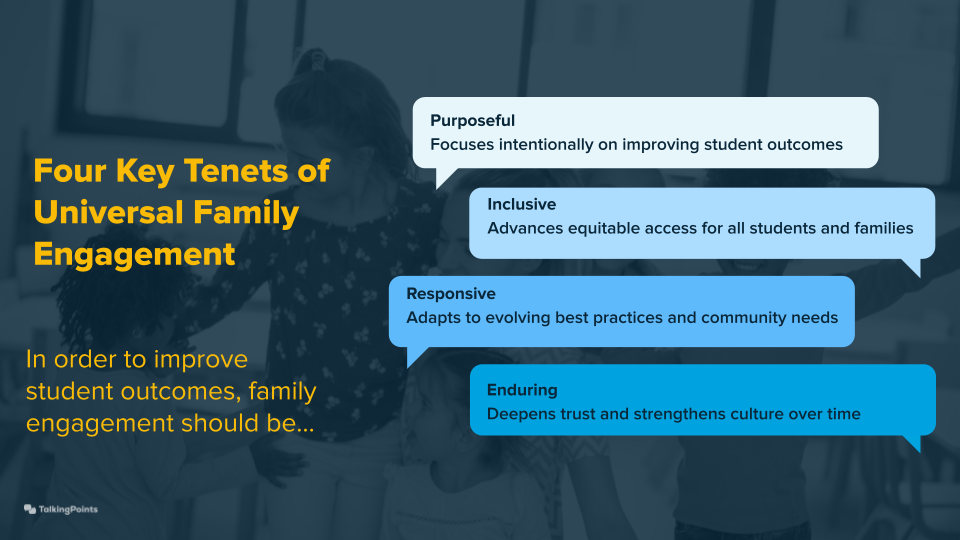
To be effective, family engagement practices need to adhere to four foundational tenets:
Purposeful – guided by research-based best practices with an intentional focus on improving student outcomes and embedded as a strategy in a school system’s outcome-focused initiatives.
Inclusive – built with universal design principles to ensure access for all families, especially those who are hardest to reach and underserved, by addressing and overcoming barriers.
Enduring – focused on deepening mutual trust, building teacher and family capacity, and strengthening school culture through sustained and reliable engagement across teachers, staff, and schools.
Responsive – adaptive to evolving student and family needs, as well as new research on proven family engagement best practices, emphasizing flexibility to align with a school district’s changing structure and community needs.
When these four conditions are systematically in place across a school district, research shows that student performance improves and school systems become more effective.
Tenet #3 – Enduring engagement
When it comes to school-family partnerships, consistency matters. In fact, it’s one of the most powerful predictors of lasting trust and improved student outcomes.
As school districts seek to engage families in meaningful ways, it’s time to prioritize not just what engagement looks like but also to what degree families can rely on consistent and predictable engagement across staff members, schools, and years. This is the foundation of enduring engagement.
What is enduring family engagement?
Enduring engagement is more than occasional communication or one-time events. It’s a sustained, reliable approach to partnership that deepens trust, builds family capacity, and strengthens school culture over time. It requires consistency across classrooms, schools, and school years.
In other words, enduring engagement doesn’t change with a teacher’s style or from one family’s child to another—it’s a district-wide commitment to families that endures throughout a child’s K–12 journey.
Enduring family engagement is a districtwide, K–12 commitment to consistent, asset-based communication and partnership with every family. It ensures families experience predictable, trusting relationships with schools year after year, regardless of teacher, school, or grade level.
Why does this matter? Because students thrive when families are confident and involved partners in their education. Families make decisions, seek support, and build relationships based on how schools make them feel—welcomed, valued, and informed. When that experience is reliable year after year, families develop trust, and students benefit from stronger, more cohesive support systems.
How to tell if your district’s family engagement is enduring
To support districts in strengthening this practice, we’ve developed a three-level rubric that describes how enduring engagement shows up in family experiences. Take a look and see where your district falls in the category of enduring engagement.
- Level 1: Beginning
Engagement efforts are inconsistent and vary widely by teacher or school. Families feel that their experience depends on who their child is assigned to, rather than any standard the district has set. Communication may be sporadic, and trust is difficult to build or maintain over the years. - Level 2: Growing
Families start to notice some consistency—perhaps from school to school, staff to staff, or year to year—but not across all three. Trust may begin to build in pockets, but the full K–12 experience lacks coherence. Engagement is improving, but not yet fully reliable or predictable. - Level 3: Enduring
Families report that communication and relationship-building are steady and responsive to their child’s needs. Whether their child is in kindergarten or high school, families know what to expect. They have confidence in the system and trust that their voice and their child’s needs will be met. This is the result of a district-wide culture of engagement that is clearly defined, supported, and sustained.

Ready to see where your district stands?
Take the Universal Family Engagement self-assessment to identify strengths and gaps in your family engagement system.
How district leaders can move from good intentions to enduring impact
Many districts have strong intentions around family engagement. But without a system-wide approach to consistency and sustainability, even well-meaning efforts can feel disjointed. Enduring engagement transforms good intentions into long-term impact. It ensures that every family—not just the most vocal or connected—has equitable access to information, relationships, and support.
Enduring family engagement checklist for district leaders
- Standardize core practices across schools and grade levels so all families experience consistent touchpoints.
- Invest in staff training on family engagement as a shared responsibility, not an optional extra.
- Use data to identify gaps in engagement consistency across schools or years.
- Create a districtwide vision for family partnership that all staff can articulate and uphold, and where family engagement, when enduring, is seen as an effective strategy to improve student outcomes.
When families know they can count on their school district year after year, they become stronger partners. And when that partnership is enduring, it becomes one of the most powerful strategies for student success.
How TalkingPoints supports enduring family engagement
TalkingPoints supports enduring engagement through features like Message Mentor, which provides best practice message writing support that produces consistent, positive, asset-based, action-oriented messaging that families will come to know and trust. Learn more about all of the features TalkingPoints has specifically designed with enduring engagement as a goal.
See TalkingPoints in action—watch a 90-second explainer video.
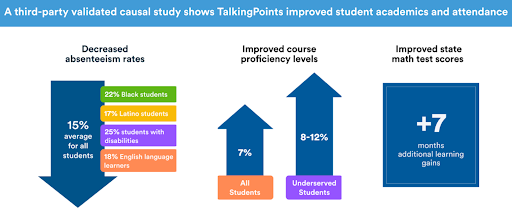
The impact of the use of the TalkingPoints platform has been validated by rigorous, externally validated causal research showing TalkingPoints leads to higher academic performance, lower absenteeism, and gap closure in both areas, as shown below.
TalkingPoints has the power to improve outcomes in your district! To learn more about our Universal Family Engagement platform and effective family engagement strategies, visit TalkingPoints.