Written by Amanda Ensor
Enrollment is on everyone’s mind right now, and for good reason. When K-12 enrollment drops, it doesn’t just affect budgets. It affects staffing, programming, school climate, community confidence, and ultimately, the student experience.
But in our recent EdWeek webinar, Stop the Drop: Turn Communication into an Enrollment Booster, we explored a critical shift in how districts can approach enrollment challenges:
Enrollment isn’t something districts “fix” at registration time. It’s something districts shape all year long—through trust.
Together with Aurora Public Schools (CO) Chief Communications Officer, Patti Moon, we unpacked what districts can do right now to strengthen family relationships, build a stronger reputation, and ultimately stabilize enrollment.

Explore three steps to “Stop the Drop” – Watch the webinar recording
Enrollment is a signal of trust, not just a number
It’s easy to treat enrollment as a number, something driven by demographics, housing patterns, or policy shifts. But as TalkingPoints Senior Content & Learning Manager, Amanda Ensor, shared during the webinar, enrollment reflects something deeper:
“Enrollment is truly a signal, not just a statistic… It’s not just about who families are, but it’s really about what families are experiencing.”
When families feel confident, they stay. They recommend. They become advocates. When they don’t, enrollment loss doesn’t always happen loudly; it often happens quietly and over time.
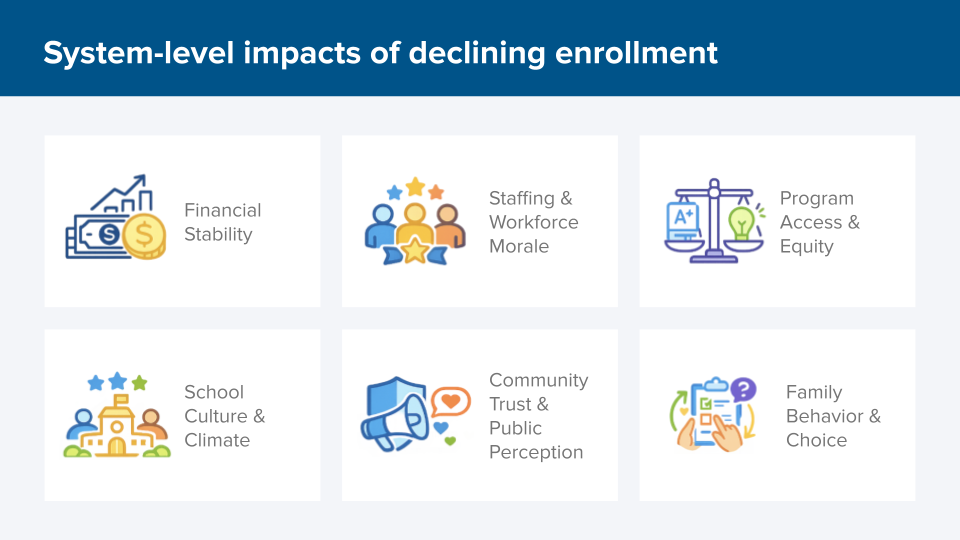
How declining enrollment affects districts
The webinar began with one truth: enrollment impacts everything about schools.
As enrollment declines, districts face ripple effects across:
- Financial stability
- Staffing and workforce morale
- School culture and climate
- Community trust and public perception
- Program access
- Family decision-making
And these impacts aren’t isolated. They compound. When budgets tighten, programs shrink. When programs shrink, families notice. When families lose confidence, enrollment drops further. It’s a cycle districts know too well.
Families choose schools based on more than academics
Many districts still assume enrollment decisions are driven by performance data. But families aren’t just asking: Is this school “good”? They’re asking:
- Will my child be supported here?
- Will we feel welcome?
Families make schooling decisions based on experience and perceived value, not just test scores or performance data. That matters even more today, as public confidence in education continues to shift.
During the webinar, Amanda shared a striking stat:
“Nearly two-thirds, 64% of current school parents, think education is on the wrong track.”
Whether or not families feel that way about your schools, that national narrative affects what families expect and what they fear. This means districts can’t afford to leave trust-building to chance.
The Enrollment Playbook: Trust → Reputation → Enrollment
One of the most important ideas from the webinar is this:
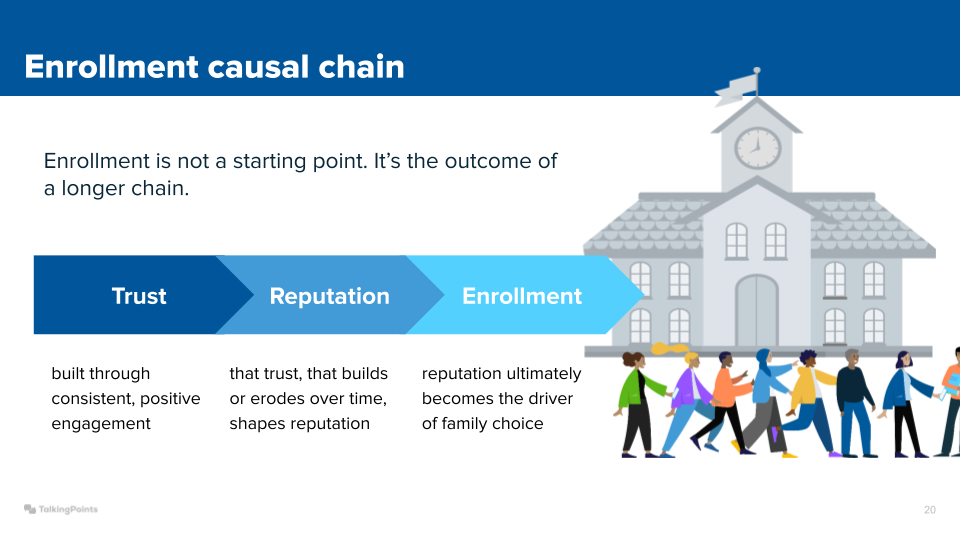
Enrollment is not the starting point. It’s the outcome.
TalkingPoints shared a simple framework called the Enrollment Causal Chain, which explains how families’ experiences shape long-term enrollment outcomes.
Trust comes first. Trust is built through everyday interactions—responsiveness, consistency, transparency, respect, and follow-through.
Trust becomes reputation. When families repeatedly experience trust, they share it. Word of mouth spreads. Community conversations shape perception.
And finally, reputation drives enrollment. By the time families enroll, their decision is often already made based on what they’ve heard, seen, and felt over time. As stated, “Enrollment is not the starting point… It’s the outcome of a longer chain.”
Aurora Public Schools: Navigating shifting K-12 enrollment with intention
Aurora Public Schools serves nearly 40,000 students across 58 schools and is the most diverse district in Colorado. Patti Moon shared that APS has experienced a common but challenging dynamic: sharp enrollment decline in one part of the district while expecting growth in another.
This led APS through a difficult but necessary planning process, including school closures and repurposing. As Patti shared, “Closing schools is one of the toughest things I think that you do in K-12 work.”
But APS also kept equity at the center of the conversation, noting that very small schools can struggle to offer the same programming and supports. “Small school budgets are not really equitably serving students… because of scale.” This reminder shifted the narrative slightly, reminding the larger community of the full story behind enrollment outcomes.
Learn how Aurora Public Schools is breaking barriers and improving student outcomes:
Read their TalkingPoints success story
Small communication moments create big relationship shifts
One of the most powerful takeaways from Patti’s story wasn’t about district strategy. It was about a teacher.
She described a staff member who noticed a student was absent, sent a book home with the student’s sibling, and then followed up with a short text exchange with the parent. The parent responded with gratitude and relief because someone noticed, someone cared, and someone offered a clear way to support learning at home.
“It was just a quick… text message exchange… but seeing that open this new relationship… is so powerful.”
That’s what trust looks like. Not a campaign. Not a slogan. Not a districtwide message blast. Just consistent, human connection.
What makes sustainable family engagement possible?
Family engagement is often framed as something districts should “do more of.” But educators are already doing too much. That’s why the webinar emphasized a key principle from implementation science. “Systems don’t fail because of lack of effort; they fail because conditions don’t support consistent practice.” To make engagement sustainable, districts need the right enablers.
Dual-level engagement matters
Family engagement must happen both:
- In the classroom, where teachers partner with families to support learning
- Around the classroom, where district and school leaders coordinate culture-building and community-wide trust
Digital engagement is essential
The webinar emphasized that in-person engagement is still important, but it isn’t enough. Families live digitally. District communication has to reflect that reality.
Digital engagement is essential.
Patti also highlighted the importance of speed and accessibility, especially when districts want real participation. She shared how APS saw survey response rates increase dramatically when they used quick text outreach with TalkingPoints instead of relying on email alone.
Co-creating a district story with families
One of the most practical strategies discussed in the webinar was the idea of building a shared district narrative with families, not just for them. The most credible voice in education is not the institution—it’s the families who experience it every day.
TalkingPoints shared a guiding question districts can use to begin:
“If families could say one true sentence about our district by the end of the year, what would it be?”
That shared “story sentence” could be something like:
- “My child is known and supported here.”
- “This district listens and responds.”
- “Every family belongs.”
From there, districts can align communication and staff support around that shared experience—so the story becomes real, consistent, and visible across every school.
Aurora’s story: A belief statement shaped by community input
Patti shared how APS went through a major rebrand using community voice to define their district identity. “We used a lot of community input in thinking about our brand… because this needs to really truly represent who we are as a district.” And she reminded the audience that even amid hard challenges, schools are filled with moments worth celebrating.
“School is magical every day… I never want us to lose sight of the magical moments that make what we do such an incredible profession.”
That kind of storytelling isn’t fluff; it’s a way of rebuilding pride, connection, and trust.
Family engagement improves far more than enrollment
When districts strengthen family relationships, the results extend beyond enrollment into outcomes that matter every day:
- Stronger attendance
- Improved academic progress
- Better educator-family relationships
- Increased inclusion and access
- Stronger school culture and climate
- Greater community confidence
As Amanda shared, “Relationships are the leading indicators of system health.” Enrollment stability becomes one of the outcomes, but not the only one.
The bottom line: trust is the earliest intervention point. If enrollment is the outcome, trust is where districts have the most influence. And trust is built through what families experience every day—especially through communication that is clear, consistent, and accessible.
Trust is the earliest intervention point. Trust builds reputation. Reputation drives enrollment.
Explore three steps to “Stop the Drop” – Watch the webinar recording
Celebrating 10 years of partnership and impact
For a decade, TalkingPoints has supported students, families, and educators through the power of effective family-school partnerships. As an education technology nonprofit, our award-winning communication and family engagement platform has improved outcomes for districts and students across the country.
We connect 9 million+ educators, students, and family members annually and have facilitated more than one billion conversations; building trust, fostering relationships, and fueling student success. Named by Common Sense Education as “the best overall family communication platform for teachers and schools,” TalkingPoints drives measurable gains in attendance and academic achievement, backed by rigorous, causal research.
Join us in building a future where every child has the support they need to thrive.