Part One of a Three-Part Series
Contributors:
- Ingrid Parker-Hill, Director of Engagement
- Michelle Thompson, Title I Program Support Teacher
- Luis Franco, Bilingual Family Engagement Coordinator
- Carrie Rogers, Family Engagement Coordinator

When Green Bay Area Public Schools (GBAPS) first began formalizing family engagement in schools, the work often meant responding to urgent needs as they came up. Thirteen years ago, the district took a pivotal step toward building stronger connections by hiring its first Family Engagement Coordinator, Luis Franco-Toscano—a move that signaled a shift toward intentional partnership with families.
Luis recalls those early days vividly: “Parent concerns were getting routed to so many different departments—it felt scattered,” he says. Back then, the work was mostly reactive. But over time, things began to change.
“It hasn’t been until the last three years or so that I can truly feel we’re developing a systemic approach to family engagement—something built to last, something sustainable,” Luis reflects.
Today, family engagement in the Green Bay School District is embedded in the district’s strategic plan, and it is part of student and school success goals.
It’s a non‑negotiable part of how the district does school.
From reactive to proactive: A district-level strategy
Michelle Thompson has worked in GBAPS for more than 30 years and now supports Title I schools and programs. Ms. Thompson has watched this evolution.
Early efforts, she notes, were about “doing something for families, such as offering an event and assigning a person or a few people to make it happen.” In recent years, leadership has shifted to treating family engagement as a true school improvement strategy:
“Our district leadership is recognizing the decades of research telling us that involved families have an impact on student achievement. If kids have families that are involved, they will perform better regardless of socioeconomic status, and that’s huge.”
She credits families themselves as a major driver:
“They ask questions. They want to be involved. They advocate for their children. They want to partner with us…They pushed us in a good way to where we are today.”
For GBAPS, the mindset is clear: all parents want what’s best for their children.
The district is responsible for creating a welcoming environment and removing barriers, ensuring families can fully engage as partners. This includes enabling communications in families’ home language, making communication easy through simple text messages, and connecting in-person opportunities and events with digital communication.
Centering trust, identity, and shared responsibility
Carrie Rogers, Family Engagement Coordinator, frames the work as building trust and shared responsibility for whole child development.
She describes the core goal:
- Families should not have to change who they are when they walk into school.
- Schools must recognize and leverage “families’ gifts” and “students’ gifts.”
- Families are treated as the student’s first teacher, and as essential partners, not as audiences.
Their work with families consistently surfaces three foundational questions parents have:
- What will my child learn this year?
- Where are they actually at academically?
- How do I help them at home?
Green Bay has started to design experiences and tools that explicitly answer these questions and empower families so conferences and events become true two‑way engagements, not one‑way information channels.
Turning a crisis into an opportunity: Enter TalkingPoints
For Ingrid Parker-Hill, Director of Engagement, the pandemic marked a turning point—and a positive one for Green Bay.
When schools closed, GBAPS adopted TalkingPoints to stay connected with multilingual families. The platform offered a simple way for staff and families to communicate in home languages, sparking rapid change.
“In the midst of the pandemic, we had to move at lightning speed to meet students’ needs,” Parker-Hill recalls. “That urgency opened a window for families to engage in ways they hadn’t before.”
What started as a multilingual communication tool has now transformed into a universal family engagement platform. TalkingPoints now serves as a districtwide connector for all families.
Parker-Hill emphasizes a guiding principle: ‘What you do for one, you can do for all.’ Today, TalkingPoints not only strengthens communication with multilingual families—it’s driving two-way engagement across the entire district.
The “Start Strong” focus: Six weeks of intentional connection
To push engagement earlier and more intentionally, Green Bay partnered with TalkingPoints on a six‑week “Start Strong” initiative at the beginning of the 2025-26 school year.
What they did
- Encouraged teachers to send a weekly series of early, relational messages to families.
- Used simple tools and templates embedded in TalkingPoints to keep the lift low and to open a channel for connection.
- Positioned “Start Strong” as part of building classroom and school culture in the first weeks, with a focus on getting to know each student.
- Shared the research-backed rationale for each outreach with school leaders to help them support their teachers.
What they saw
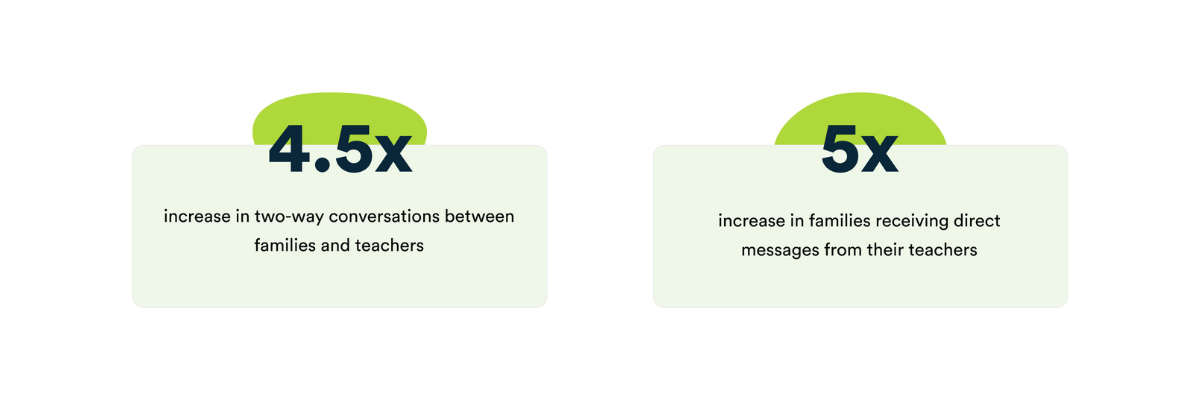
- Noticeable increases in two‑way messaging—teachers weren’t just broadcasting; they were hearing back and starting real dialogues about their new students, ultimately seeing a 4.5x increase in two-way conversations between families and teachers as compared with the same period last year.
- Word‑of‑mouth momentum: teachers who tried TalkingPointsit and saw results began emailing colleagues to say, “You’ve got to check this out.”
- Overall, the 21 participating schools saw a 5x increase in families receiving direct messages from their teachers.
Ms. Parker-Hill is proud of the outcomes, but she also sees room to improve. Providing more time for prep and planning would help it become part of each school’s back-to-school plans. While this year’s initiative was focused on only half of the GBAPS schools, Parker-Hill hopes to include all schools across the district next year.
“Sometimes you have to act when the opportunity presents itself—and that’s exactly what happened with the Start Strong pilot. Although it came together quickly, early data and qualitative feedback convinced Green Bay that this approach works and should become part of ongoing improvement cycles—not just a one-time effort. It’s a low-lift, high-impact way to boost student success, and leaders are now exploring how to embed these habits throughout the school year.”
Building habits, not one-off campaigns: 100-day improvement cycles
A key part of Green Bay’s overall approach is its continuous improvement structure. Each school operates on 100‑day improvement cycles, which includes:
- Conducting a needs assessment and creating a school success plan.
- Implementing for 100 days, then analyzing what’s working and what isn’t.
- Being agile and adjusting plans for the next 100‑day cycle.
Ms. Parker-Hill sees initiatives like Start Strong fitting naturally into this model:
- Early-year Start Strong activities to help kick off relationships.
- A midyear “reboot” or second Start Strong‑style push as schedules and rosters change.
- Continuous reminders and supports so communication becomes a habit, not a special event.
She’s explicit that this is a culture shift:
“When people aren’t used to something, it takes time to build the habit—so we’ll need to provide support and gentle encouragement along the way. Since our families are the end users, our district’s next steps are to continue monitoring gaps and working to bridge them.”
What makes Green Bay’s approach different
- Systemic, not personality‑driven
They are deliberately building policies, expectations, and structures so that when individuals “come and go, the great things…are not going with those individuals as well.” - Research‑aligned and data‑informed
They ground the work in decades of research on family engagement and student achievement, and they look at their own communication and event data to refine practice. - Rooted in trust and identity
Events and experiences go beyond “involvement” to true engagement: culturally relevant author visits, shared meals, and explicit coaching for families on what to ask and how to advocate. - Tools in service of relationships
TalkingPoints is not “the strategy,” it’s an enabler that:- Removes language barriers
- Makes it easier for staff to send quick, meaningful messages
- Opens a two‑way channel where families can ask questions, engage in a shared dialogue, and stay connected to their school
TalkingPoints helps to enable one goal shared by Green Bay schools and their families: each wants what’s best for their students.
This post is part two of our Green Bay Area Public Schools (GBAPS) co-authored series on how schools are using TalkingPoints to build stronger relationships with families.
Contributors:
- Courtney Kuehn Principal
- Tim Larsen, Associate Principal
- Luis Franco, Bilingual Family Engagement Coordinator
Today we’re spotlighting Preble High School, Wisconsin’s third-largest high school, with 2,200 students and 275 staff, and highlighting how its leaders are proving that “big” doesn’t have to mean “impersonal.”
Principal Courtney Kuehn is clear about Preble’s philosophy: size will never be a barrier towards building and developing personal family relationships. Kuehn sums it up succinctly: “…the only bad communication is the communication that never happens.”
“We are big, but families need to be in communication with their teachers. They deserve to know what’s going on within their child’s education. While we are big, we want to make sure that we’re not using that as an excuse not to be responsive to our families.”
That belief shows up in small but powerful ways. For example, Preble hand-signs every honor roll certificate—no electronic signatures—because they refuse to let scale get in the way of a personal touch. As Kuehn puts it, they don’t want to be “defined by our size in a negative sense,” but instead want that size to be “a true asset to everything that we can provide.”
Turning a large school into a network of relationships
Associate Principal Tim Larsen notes that a school of Preble’s size could easily feel anonymous. Instead, the leadership team has made a conscious decision to turn scale into a strength by being systematic and personal.
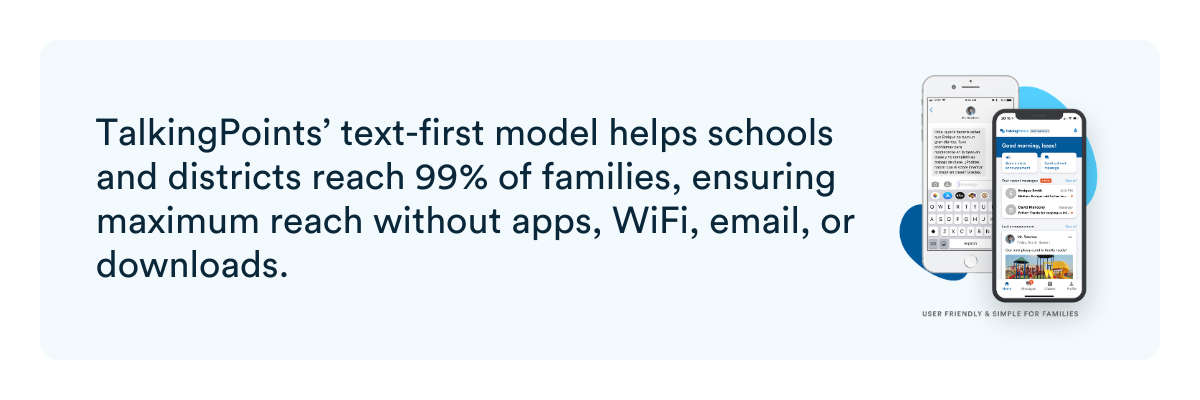
One key driver of that work: TalkingPoints.
When the platform was first rolled out, some staff were unsure about it.
“When TalkingPoints was first rolled out to staff, I think naturally some staff saw it as, okay, I’m sending a text message to families? Somehow that might seem… unprofessional,” Larsen recalls.
Kuehn and Larsen tackled that directly during August back-to-school prep, using training and hands-on practice to reframe TalkingPoints as a way to “meet families where they’re at” and communicate in ways that are convenient and accessible for them.
They started simple. During a staff meeting, everyone opened TalkingPoints and sent one positive message to one family. That low-stakes first action helped build comfort and confidence, and usage quickly grew from there.
Start Strong: Using data to drive family engagement in high schools
Preble’s deeper push into TalkingPoints came with GBAPS’s Start Strong initiative: a six-week effort at the beginning of the school year across 21 schools to proactively get to know families and their students in those crucial early weeks.
At Preble, that work was rooted in data. The school had surveyed both students and families and saw a clear theme: a need for stronger belonging.
“We take our surveys very seriously… a sense of belonging comes through frequently,” Kuehn explains.
They paired that with TalkingPoints usage data from the previous year and saw that many instructional staff were still hesitant to use the platform, often because they weren’t confident that messages would go where they intended or translate the way they hoped.
Larsen led targeted onboarding and support sessions to close that gap, building staff capacity and comfort. Start Strong added structure and momentum:
- Teachers received weekly TalkingPoints activity ideas and question prompts to spark two-way conversations with families.
- Administrators got parallel messages that explained the research behind those prompts and suggested ways to encourage staff.
The goal was to make it easy for teachers during the busiest part of the year to take that “extra step” and initiate real dialogue with families from day one.
The results:
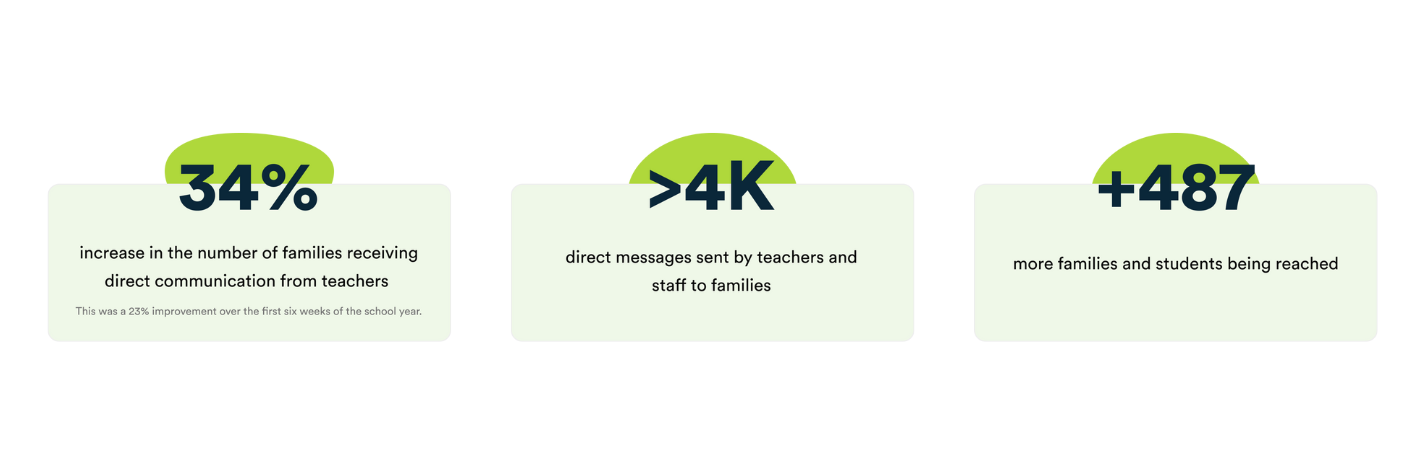
- 34% increase in the number of families receiving direct communication from teachers, which was a 23% improvement over the first six weeks of the school year
- 487 more families & students being reached at Preble in those early weeks
- The momentum continued with 4,148 direct messages sent by teachers and staff in the first semester, and 4,361 direct messages sent by families in that same time frame
From “too-late” conferences to formative, helpful communication
One place where TalkingPoints has been especially powerful is Preble’s “unit-by-unit” grading system. All coursework for a unit is due by the end of that unit, so clear, timely communication matters.
Before TalkingPoints, parent-teacher conferences were one of the main structured touchpoints. But Kuehn notes, relying on conferences alone has its limits. In the past, they used conferences to give families a snapshot of where their students were in a given unit, but it was often too late if students had missed a deadline. With TalkingPoints teachers are regularly communicating about key milestones so students are supported from multiple sources, specifically:
- Staff send reminders about unit deadlines, what content to study, and what assignments are still missing.
- Families respond with specific questions, like noticing a missing assignment and asking about its status.
- Teachers reply in real time, clarifying what’s already in the gradebook and what’s still being entered.
Mr. Larsen notes, “Rather than just retroactively waiting to see what’s going to show up in our student information system, they can have that real time conversation earlier. And as a result, the relationships grow a lot closer,” and families are able to offer support along the way.
Using technology to feel more human, not less
In a large school, efficiency is essential, but Preble’s leaders insist it can’t come at the cost of relationships. Larsen highlights how certain TalkingPoints features help them to build these personal relationships.
“When sending messages to multiple families, it’s so slick. As parents, we love to see our student’s name in the communication, not just something generic like ‘your child.’ TalkingPoints lets you easily insert the student’s name, even when sending a message to multiple families. It makes the teacher’s job easier, but more importantly, it makes the communication more powerful.”
It’s not just teachers using the platform. The administrative team relies on TalkingPoints for attendance conversations and re-engagement support. Larsen shares that having these relationships lays the foundation for other conversations with students, whether it’s an attendance issue or an academic one. And just knowing how a family wants to be communicated with makes that communication more efficient and effective.
If a family works during the day and can’t answer calls, Laren uses TalkingPoints instead:
“They’ll be able to check that message and respond to it on their own time. For many of our families, Talking Points is now their preferred method of communication.”
Family engagement provides the glue to build success from elementary to graduation
Family Engagement Coordinator Luis Franco-Toscano connects Preble’s work to a broader, long-term view. He has served Green Bay schools for 27 years, thirteen of those as a family engagement coordinator supporting the “Preble track,” families from elementary that feed into Preble High School. All three of his own children attended Preble, so his connection to the school is both professional and personal.
He describes Preble as a model for the district in how it approaches everything from an open house to registration, with “many different resources that are not only language sensitive” and a clear focus on building relationships from day one.
From Mr. Franco-Toscano’s conversations with families, one theme stands out: messages sent through TalkingPoints feel deeply personal.
“A lot of the parents feel like those are personal invitations. They have a personal relationship with a teacher. They have a personal relationship with a counselor. They feel contextualized on a personal matter.”
Franco-Toscano feels these relationships built in the earlier years help as students transition from school to school, helping students and families feel more immediately connected. Franco-Toscano says: “Things get a little murky, where the family has to maneuver through different apps, different resources [at different schools] to achieve the same common goal.” However, TalkingPoints helps the communication and personal connections stay consistent across the school years.
Mr. Franco-Toscano says TalkingPoints provides:
- Continuity across grade levels and buildings
- Reduced anxiety for families who might otherwise feel “not be in the know”
- Stronger cultural identity and access through translation and multilingual support
For Franco-Toscano, TalkingPoints is “the humanizing aspect of an academic environment,” something he notes is “not as common as you would think” in other edtech tools.
Advice for school leaders
For other principals and school leaders considering a deeper investment in family engagement as a key strategy, the Preble team offers this advice:
- Start small to build trust and confidence. Have staff send one simple, positive message during a meeting. It’s a quick way to lower the stakes and demonstrate how easy and impactful the tool can be.
- Protect time for practice. Don’t assume staff will “just figure it out.” Preble’s August onboarding and support sessions were critical to overcoming hesitation and building real comfort with the platform.
- Be systematic, but still personal. Especially in large schools, taking advantage of TalkingPoints features like personalizing group messages help you communicate efficiently without sacrificing that “this is about your child” feeling.
- Meet families where they are. When families can respond on their own time, and in their own language, engagement goes up.
- Think long-term. Treat communication as a continuous journey—from registration to graduation—not a set of isolated events.
Two ideas for school and district leaders to consider as they evolve their family engagement initiatives.
For Preble High School, family engagement isn’t an extra initiative; its core to how a large, complex school becomes a connected community. And TalkingPoints is one of the key tools helping them live out that belief, one message and one relationship at a time.
This post is part three of our Green Bay Area Public Schools (GBAPS) co‑authored series on how schools are using TalkingPoints to build stronger relationships with families.
Contributors:
- Lori McArthur, Principal
Today we’re spotlighting Nicolet Elementary School—a bilingual, neighborhood school where deep community roots and new communication habits are helping families feel seen, heard, and connected.
Principal Lori McArthur has worked at Nicolet Elementary for 28 years. She now leads a school where many of her current students are the grandchildren of her former students. The community is close‑knit and diverse, with predominantly Spanish‑speaking families and additional home languages including Hmong, Somali, and Haitian Creole.
Like many schools, Nicolet has faced challenges in elementary family engagement:
- Families working multiple jobs and juggling complicated schedules
- Parents who felt intimidated by school settings and educators
- Language barriers that made consistent, two‑way communication difficult
Despite these barriers, one thing has always been clear to McArthur: families care deeply about their children. The challenge has been finding ways to help them connect to what is going on at school that is accessible, respectful, and sustainable for staff and families alike.
This year, Nicolet’s participation in Green Bay’s Start Strong initiative, supported by TalkingPoints, helped the school take a significant step forward. This six-week outreach effort, starting at the beginning of the school year, set out to connect early with families, learn about every student, and build and establish relationships with all families.
From scattered tools to one goal: Open up two-way conversations
In previous years, communication at Nicolet varied widely from classroom to classroom.
“Last year we had different things going on,” Lori explained. “We had teachers doing Seesaw, using other apps and making phone calls. We had teachers spending time communicating in all of these different ways. The challenge that we ran into with that is that parents wouldn’t answer the phone, and there wasn’t a clear channel to expect and engage in communication with the school.”
Heading into the 2025–26 school year, McArthur and her staff wanted to focus on building regular, two‑way communication between teachers and families. McArthur notes, “We wanted to have a two‑way conversation between teachers and families. And as I have a generally younger staff, communicating by texting was natural and easy.”
To take advantage of TalkingPoints’ text-first approach, Nicolet made TalkingPoints the primary platform as it was reaching more families, enabling home language communication, and most importantly, opening a door for a two-way conversation.
Launching with intention: Open house + Start Strong
Nicolet used the beginning of the school year to embed TalkingPoints into the fabric of their routines.
What they did
- Printed TalkingPoints flyers to build awareness for families and prepared staff to support enrollment
- Used their back‑to‑school open house to walk families through setup and answer questions on the spot.
- Provided directions in multiple languages and explicitly framed TalkingPoints as the main way families would hear from the school and their child’s teacher.
- Sent follow‑up reminders during the second week of school and a clear message: “We’re all trying to get on TalkingPoints—here’s why.”
What they saw
As part of the district’s six‑week Start Strong initiative with TalkingPoints, Nicolet focused their early-year outreach on relationship building, not logistics. Teachers received simple prompts and activity ideas designed to:
- Introduce themselves in a personal way
- Ask families about their child as a person and a learner
- Share early photos and stories from the classroom
- Invite questions and feedback
For Nicolet, this approach paid off quickly.
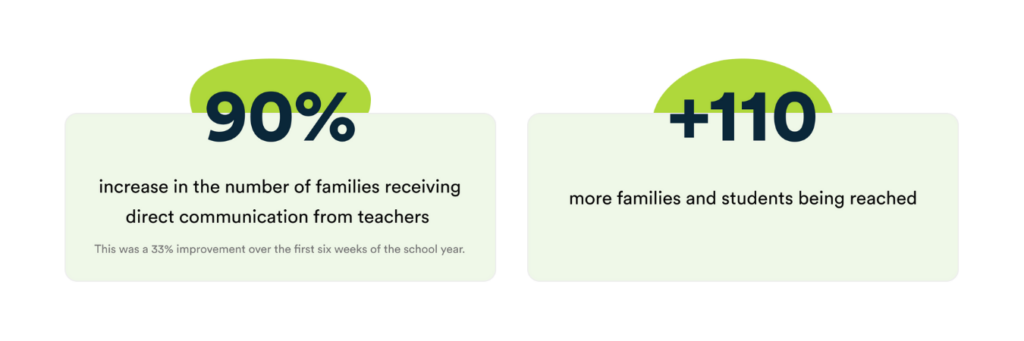
The results:
-
- 90% increase in the number of families receiving direct communication from teachers – a 33% improvement since the start of this project
-
- 110 more families & students being reached
Language access as a foundation, not a bonus
As a bilingual school serving a multilingual community, Nicolet’s family engagement work depends on clear communication in families’ home languages. That’s where TalkingPoints’ translation has been critical.
“That’s a big thing for us,” McArthur emphasizes. “We’re a bilingual school. So TalkingPoints makes it easy to translate messages and videos for us rather than me having to get it done ahead of time.”
Teachers who don’t share a family’s home language can still communicate confidently. They write in English, and TalkingPoints translates into the family’s language. Families respond in their home language, and messages are translated back for the teacher.
Making communication more personal
While McArthur is a principal who loves connecting in person, “I’m more of a go out and talk to the parents,” she also recognizes that many families feel more comfortable engaging via their phones. To bridge that gap, she set a personal goal: send a video to families at least once a month through TalkingPoints. Just to give quick updates and so they can see me and talk,” she explains. And she’s noticed more responses over time.
How she uses it
- Records brief video messages directly in TalkingPoints
- Keeps it short and focused
- Uses the automatic translation for videos, so every family can understand the message in their home language
- Changes the times she sends the messages to find the best time, and it turns out mid-afternoon tends to be when families engage most
“I’ve kind of got it down,” she says. “I know how many characters it needs to be. So I’m really quick, concise and to the point. I’ve had great positive feedback from families.”
For Nicolet, these videos do more than share information: they help families put a face and voice to “the principal” and reduce the intimidation factor that can come with entering the building.
Ms. McArthur shares why family (and how) family engagement is making a difference in their school.
Messages that build a positive attendance culture
Nicolet has also begun using TalkingPoints to address a perennial challenge: attendance.
McArthur noticed a concerning pattern at Nicolet: students being consistently picked up early. “We saw this trend around picking up students at 3 o’clock. They’re missing 25 minutes of school every day,” she explains. “And 25 minutes every day adds up to be a considerable amount of school.”
Using TalkingPoints, Nicolet sends short, translated messages with the goal of educating families on the importance of attendance and why it matters. These messages are simple and straightforward, and they:
- Explain how frequent early pickups add up to significant lost instructional time
- Share simple, visual examples of what that missed time looks like over weeks and months
- Help families see the long‑term impact on learning, without blame or shame
Nicolet uses a combination of their own personalized messages along with the TalkingPoints Attendance Weekly Messaging Series, which are pre-built, research-backed messages that aim to educate and motivate families to ensure their students are in school.
The impact has been noticeable:
- Fewer families are picking students up early
- Some parents responded, saying they “never realized” the cumulative effect
- Attendance conversations feel more like shared problem‑solving than enforcement
Real‑time connection and partnership in the classroom
The impact of these new habits appears in small, everyday interactions between families and teachers. McArthur sees it in messages like: “…[student] has had a difficult morning. Could you just touch base with him? Let me know if you need anything.”
“For a teacher to get that beforehand, that’s a lot more helpful,” she says. And it’s reassuring for parents, “They know they can get right through to the teacher. If they call the desk or if they’re here, they’re not going to get through to the teacher. This is quick and easy.”
She also emphasizes the importance of having the foundation of these two-way connections and conversations, it is all part of building trust and relationships.
“If you get something from a parent, you need to respond back, because that’s what they’re looking for,” she tells her team. “That’s what’s going to build that trust. That is what’s been much better this year.”
Thoughts for school and district leaders to consider.
Advice for elementary school leaders
For other principals and school leaders considering a deeper investment in family engagement for elementary schools and tools like TalkingPoints, McArthur offers several lessons from Nicolet’s journey:
- Treat family engagement as partnership. “Family engagement is partnering,” she says. “It’s a give and take, back and forth. Instead of us telling them, we need to ask them, and we need to work with them.”
- Don’t confuse silence with disinterest. Many Nicolet families work multiple jobs or carry difficult past school experiences. “We can’t assume that they don’t care about their kid because they’re not answering you or because they don’t show up,” says McArthur. “Everyone cares. It shows differently for each person.”
- Meet families where they already are—on their phones. Long emails and phone calls aren’t always realistic. Quick, translated text messages are much more accessible for many families and staff.
- Make it a schoolwide expectation, not an optional extra. Setting TalkingPoints as a school goal, launching it at a back-to-school open house, and modeling it as a principal helped Nicolet move from scattered efforts to a coherent approach.
Looking ahead
As the school year continues, McArthur and her team plan to keep building on what’s working:
- Expanding the use of TalkingPoints for family events and invitations
- Continuing monthly principal video messages
- Encouraging more teachers to experiment with videos, photos, and surveys
- Integrating attendance education and family voice into ongoing communication
For Nicolet Elementary, TalkingPoints is not “the strategy” on its own. It’s a practical, everyday tool that helps make a long‑standing belief visible: families are essential partners in student success, and schools have a responsibility to meet them where they are.
Across this three‑part series—from the district lens, to Preble High School, to Nicolet Elementary—the throughline is clear. When schools honor families’ perspectives, remove barriers like language and time, and commit to two‑way communication as a core part of their work, family engagement becomes less of an event and part of the culture.